Updated 6 months ago
Impact of Natural Gas Volatility on 2026 Residential Electricity Rates
Written by
Irena Martincevic
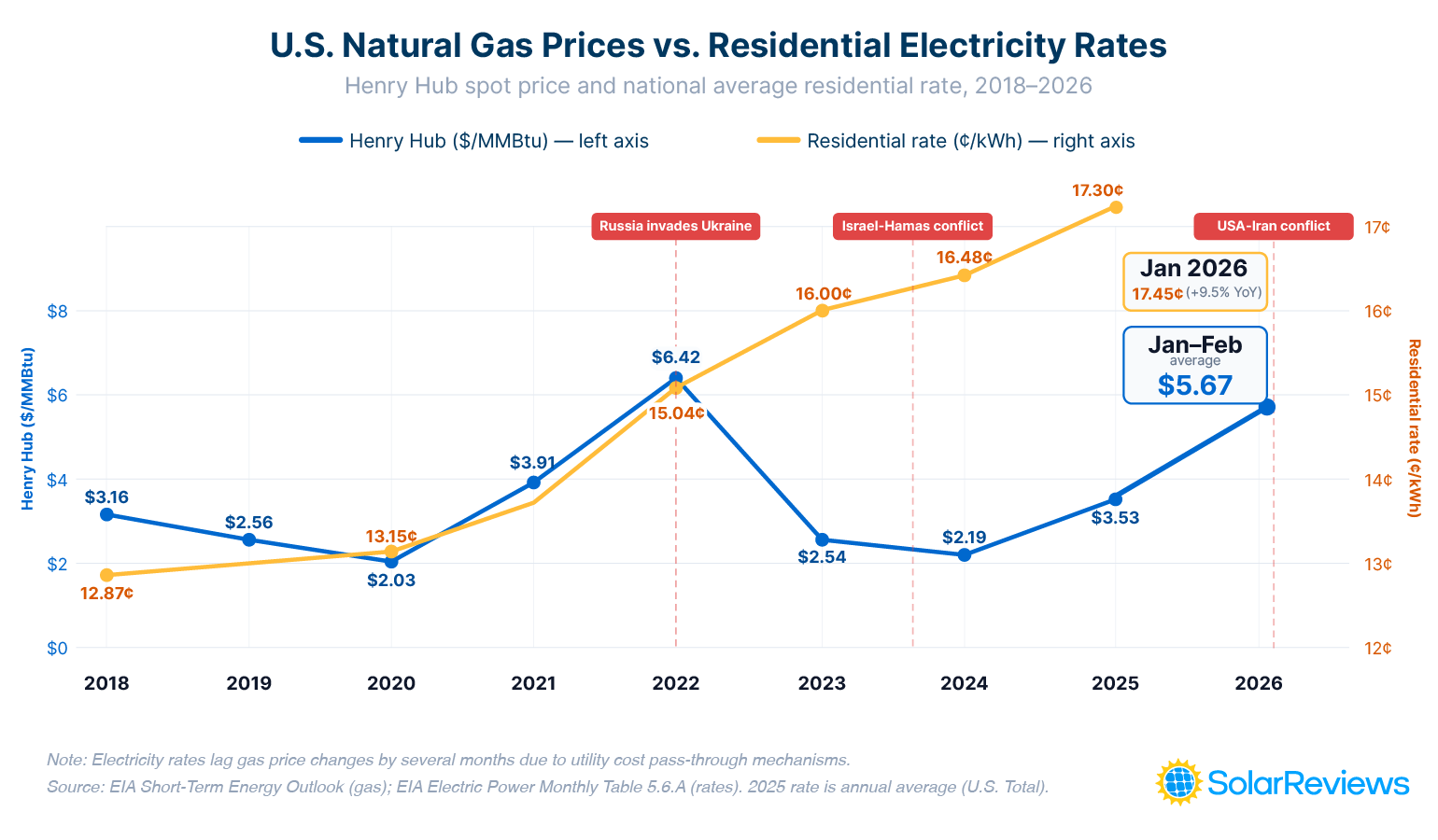
In January 2026, the national average residential electricity rate reached 17.45¢/kWh, representing a 9.5% increase from the previous year. This upward trend is primarily driven by volatility in the natural gas market and geopolitical instability, both of which influence utility operational costs across the United States.
Homeowners are increasingly evaluating solar energy as a structural method to stabilize long-term energy expenditures. While traditional utility rates remain susceptible to external market shocks—such as the price surges observed during Winter Storm Fern—solar power provides a fixed-cost alternative that mitigates the financial impact of grid-wide price fluctuations.
Key takeaways:
-
Market price divergence: Natural gas prices spiked to $7.72/MMBtu in January 2026, while solar energy maintains a fuel cost of $0.00/kWh once the system is installed.
-
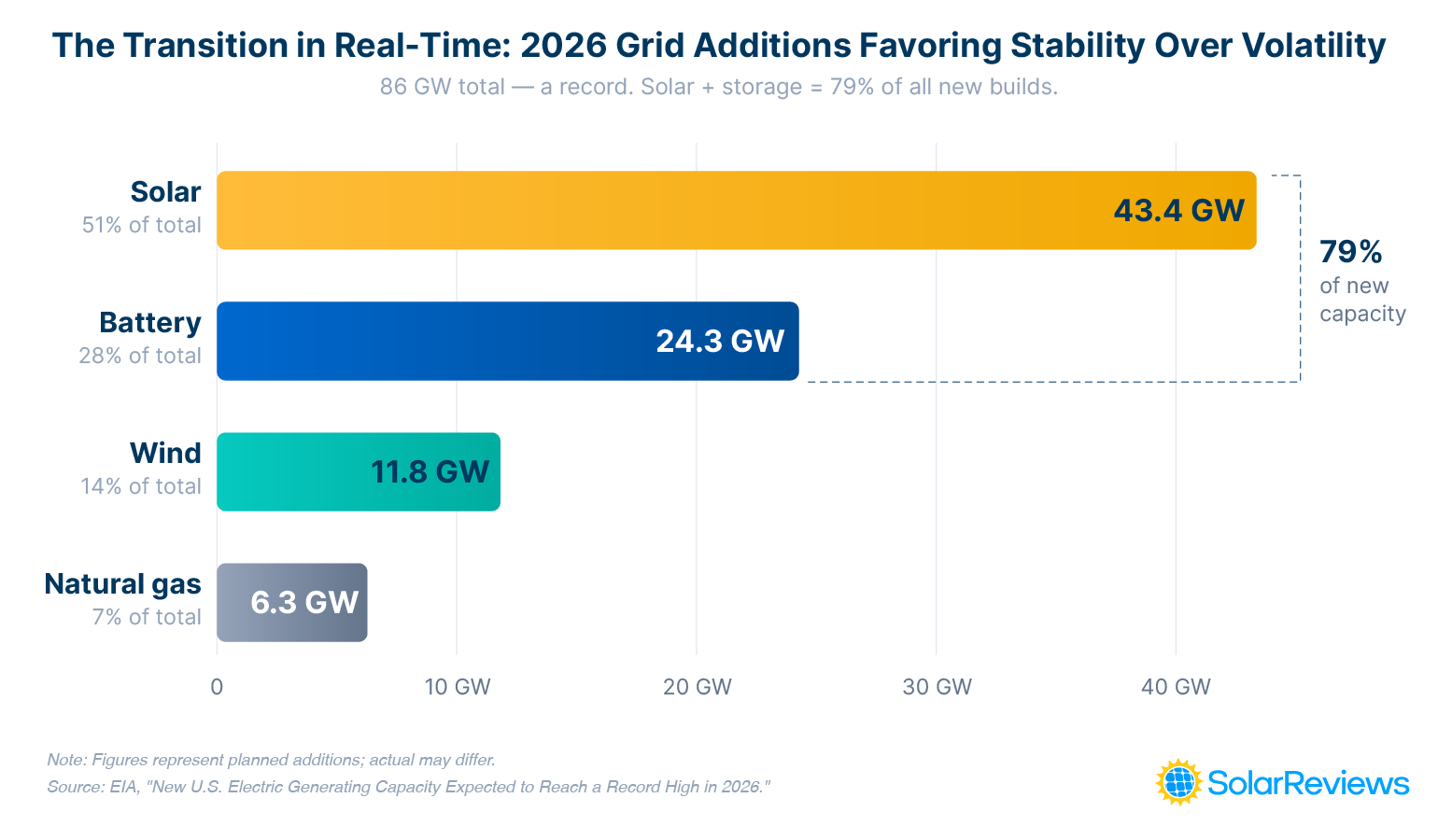
Grid capacity transition: 79% of new power capacity scheduled for 2026 consists of solar and battery storage. This confirms the continued trend toward renewable assets to reduce exposure to fuel-cost volatility.
-
Strategic planning: The 2026 energy market requires a detailed 5-step audit of utility fuel surcharges and local grid risks to determine the optimal balance between system ownership and third-party leasing.
Why your bill keeps changing: Commodity volatility and the "Fuel Adjustment Clause"
Most homeowners are surprised to find that their electricity usage isn't the only thing determining their monthly total. Utility providers use a Fuel Adjustment Clause (FAC) to pass the variable costs of commodities—like natural gas—directly to the consumer.
Because natural gas generates approximately 40% of U.S. electricity, your bill is highly sensitive to market shocks. For the homeowner, this means:
Sudden surcharges: When gas prices spike, you don't wait for a yearly rate hike; you see a "Fuel Cost Adjustment" or "Power Recovery" surcharge on your next statement.
Market vulnerability: During the first quarter of 2026, two specific shocks hit the grid:
Winter Storm Fern: This event triggered production "freeze-offs," sending gas prices to $7.72/MMBtu—an 81% increase in just 30 days.
Geopolitical instability: Conflicts in the Middle East have caused wholesale electricity costs to fluctuate wildly, creating "bill shock" for households in gas-dependent regions.
Solar energy acts as a structural hedge against this instability. By generating power on-site, a residence effectively locks in a fixed-cost structure for 25 years. While average utility rates have risen nearly 5% annually since 2019, solar-equipped properties are insulated from the supply chain disruptions that dictate wholesale pricing.
The "Ratchet Effect": Why rates keep climbing (even when gas gets cheap)
The data below reveals a frustrating reality for homeowners: your bill is quick to rise when gas prices spike, but slow to fall when they normalize.
Utilities often experience a "lag effect" in billing. When commodity prices collapse—as they did in 2023 and 2024—retail electricity rates often keep rising. This is because utilities use those periods of lower fuel costs to recover expenses from previous infrastructure damage, grid aging, and transmission upgrades.
Visualizing long-term cost stabilization
.png)
For a homeowner, the choice is between paying for energy at a variable rate or securing a fixed-cost asset. While the "grid" represents a 25-year cycle of unpredictable surcharges, solar provides a stable cost structure.
In high-gas regions, a standard grid-connected home is projected to spend between $79,000 and $119,000 over the next 25 years, depending on market volatility. In contrast, a solar-equipped home maintains a predictable expenditure of approximately $39,000.
The 2026 grid response
The U.S. power grid is undergoing a transition to stabilize long-term costs. In 2026, developers plan to add a record 86 GW of new capacity, a 62% increase over the previous year.
Solar (51%): 43.4 GW of planned additions.
Battery storage (28%): 24.3 GW of planned additions.
Natural gas (7%): 6.3 GW of planned additions.
The shift toward solar and storage at the utility scale mirrors the economic incentives for individual households: the elimination of fuel-cost exposure. Additionally, the U.S. Department of Energy (DOE) has launched the $1.9 billion SPARK initiative to modernize transmission infrastructure, intended to improve grid reliability as electrical demand from data centers and industrial hubs increases.
Navigating solar in 2026
The termination of the Section 25D residential credit on December 31, 2025, has altered the financial landscape of solar adoption, shifting focus toward different ownership and resilience models.
The rise of leasing: Solar leases and PPAs allow homeowners to benefit from federal tax incentives via the Section 48E pass-through, often resulting in immediate bill reductions with no upfront capital.
The power of ownership: For those who choose to own, the loss of the federal credit is increasingly offset by high utility rates and state-level performance payments, such as SRECs.
The battery mandate: Integrating battery storage is now becoming essential. It transforms solar from a simple daytime saver into a 24/7 energy insurance policy, protecting your home during outages and "peak-price" utility windows.
What to do now: A 2026 homeowner checklist
Navigating the 2026 energy landscape requires a strategic audit of a home's relationship with the grid.
Step 1. Audit your utility bill for "hidden" surcharges
Examine utility statements for line items labeled "Fuel Cost Adjustment," "Energy Charge Adjustment," or "Power Cost Recovery." These surcharges typically reflect fuel costs incurred 60 to 90 days prior; a price spike in January often results in higher surcharges on spring or summer bills.
Step 2. Identify your local grid's "fuel risk"
Your vulnerability to global conflict depends on what your utility burns.
Verify the fuel mix: Check your utility's annual disclosure or the EIA's state-level data. Utilities relying heavily on single-fuel natural gas generators are at the highest risk for both price spikes and winter blackouts.
Assess local demand growth: If you live in a high-growth region like Texas (ERCOT), where EIA forecasts electricity load growth averaging 10% annually through 2027 driven by data centers, your rates face significant upward pressure.
Step 3. Evaluate your 2026 solar and storage options
With the termination of the 25D tax credit, the math for solar has changed.
Lease vs. buy: If you purchase a system with cash or a loan in 2026, you receive $0 in federal tax credits. However, solar leases and PPAs still qualify for the 30% Section 48E credit because the installer owns the system and passes the savings to you.
Explore local and state incentives: State-level programs are more important than ever. Many states offer their own incentives.
Prioritize battery storage: With the grid increasingly prone to shortfalls during extreme weather, a home battery system is essential for maximizing energy independence. These systems transform solar power into a 24/7 "insurance policy," protecting your home during outages and helping you avoid expensive "peak-price" utility windows. You can compare different battery storage options here to find the best fit for your home’s energy needs.
Step 4. Future-proof your home
Successful energy stabilization requires planning for a 25-year horizon. Before installing solar, assess your roof's condition — it should be sound enough to last the life of the panels. Systems should be sized to accommodate future increases in demand, such as the addition of electric vehicle (EV) chargers or heat pumps, to avoid the higher costs of secondary installations.
Step 5. Verify your installer and avoid scams
The rapid expansion of solar in 2026 has brought out bad actors.
Check credentials: Ensure your installer is certified by the North American Board of Certified Energy Practitioners (NABCEP).
Verify warranties: Look for workmanship warranties of at least 10 years and product warranties of 10–12 years for panels and inverters.
Review financial disclosures: Carefully read all documents before signing a lease or PPA to understand any "escalator" clauses that might increase your monthly payments over time.
Solar as a structural solution
Switching to solar generation represents a shift from variable energy pricing to a fixed-asset model. By generating your own power, you effectively lock in a fuel cost of $0/kWh for the next 25 years. While electricity rates have risen at an average of nearly 5% annually since 2019, a solar-powered home operates on a fixed, predictable cost structure.
As the federal government invests $1.9 billion through the SPARK initiative to modernize the nation's "macro-grid," you have the power to modernize your home's "micro-grid" today. By following our 2026 Homeowner Checklist, you can stop reacting to the energy market and start controlling it.
Methodology and sources
Irena is an industry analyst and content specialist at SolarReviews, where she transforms complex data into clear insights that help readers make smarter financial decisions regarding clean energy. She holds a degree in Economics and has been conducting personal finance research since 2018, bringing a strong analytical foundation to her work. Her insights have been featured in reputable outlets such as the Washington Examiner, Yahoo Finance, Fox4...
Learn more about Irena Martincevic