Updated 8 months ago
4 Ways Solar Panels Protect You From Rising Electric Bills
Written by
Andy Sendy
Discover how much you can save on average by installing solar panels
Installing solar panels comes with a wide range of benefits, like lowering your monthly electric bills, gaining energy independence, and reducing your carbon footprint. But, one major advantage many homeowners overlook is protection from rising utility rates.
Electricity prices in the U.S. have risen steadily over time. Residential electricity prices have increased by an average of 2.85% per year over the last 25 years with current rates hovering around $0.17 per kilowatt-hour (kWh). By going solar, you can lock in lower energy costs and shield yourself from unpredictable rate hikes – making now a smart time to make the switch.
Key takeaways
-
Solar panels provide a hedge against rising electricity rates by reducing reliance on grid power.
-
Electricity rates have increased by an average of 2.85% annually over the past 25 years.
-
Solar panels allow for energy independence, a levelized cost of energy, net metering benefits, and reduced stress on the electrical grid.
-
Electricity prices rise due to fuel costs, infrastructure upgrades, and changing policy environments.
How much do electricity prices increase each year?
State | Avg. rate of increase | 1999 Rate (cents/kWh) | 2024 Rate (cents/kWh) |
California | 4.54% | 10.50 | 31.86 |
Hawaii | 4.53% | 14.10 | 42.72 |
Massachusetts | 4.40% | 10.00 | 29.35 |
Rhode Island | 4.13% | 10.20 | 28.07 |
Connecticut | 3.73% | 11.50 | 28.76 |
Oregon | 3.70% | 5.90 | 14.63 |
West Virginia | 3.56% | 6.30 | 15.10 |
Wisconsin | 3.49% | 7.30 | 17.22 |
Washington | 3.45% | 5.10 | 11.90 |
Kentucky | 3.42% | 5.60 | 12.98 |
District of Columbia | 3.23% | 8.00 | 17.72 |
Alaska | 3.22% | 11.20 | 24.71 |
Michigan | 3.19% | 8.80 | 19.29 |
Idaho | 3.16% | 5.30 | 11.54 |
Alabama | 3.07% | 7.10 | 15.12 |
Maryland | 3.07% | 8.40 | 17.88 |
Nevada | 3.04% | 7.10 | 15.00 |
Indiana | 2.99% | 7.10 | 14.84 |
Minnesota | 2.93% | 7.50 | 15.42 |
Mississippi | 2.90% | 6.50 | 13.29 |
Colorado | 2.88% | 7.40 | 15.06 |
Pennsylvania | 2.81% | 8.90 | 17.79 |
Tennessee | 2.79% | 6.30 | 12.54 |
Texas | 2.74% | 7.60 | 14.94 |
Wyoming | 2.71% | 6.40 | 12.50 |
Virginia | 2.68% | 7.50 | 14.54 |
Georgia | 2.57% | 7.50 | 14.14 |
Kansas | 2.54% | 7.60 | 14.22 |
South Carolina | 2.51% | 7.60 | 14.13 |
Oklahoma | 2.50% | 6.60 | 12.24 |
Illinois | 2.49% | 8.60 | 15.92 |
Ohio | 2.48% | 8.70 | 16.07 |
Delaware | 2.44% | 9.00 | 16.45 |
Utah | 2.44% | 6.20 | 11.33 |
Maine | 2.43% | 13.10 | 23.89 |
Missouri | 2.42% | 7.10 | 12.91 |
Florida | 2.41% | 7.80 | 14.15 |
Nebraska | 2.39% | 6.50 | 11.74 |
Vermont | 2.38% | 12.30 | 22.14 |
North Dakota | 2.30% | 6.50 | 11.49 |
Montana | 2.29% | 7.20 | 12.67 |
South Dakota | 2.29% | 7.40 | 13.03 |
New York | 2.27% | 13.90 | 24.37 |
North Carolina | 2.25% | 8.10 | 14.12 |
New Jersey | 2.11% | 11.50 | 19.38 |
Arkansas | 2.09% | 7.30 | 12.24 |
New Hampshire | 2.09% | 13.90 | 23.33 |
Arizona | 2.05% | 9.00 | 14.95 |
Iowa | 2.03% | 8.20 | 13.55 |
New Mexico | 2.03% | 8.70 | 14.37 |
Louisiana | 1.94% | 7.20 | 11.64 |
U.S. Average | 2.85% | 8.17 | 16.48 |
Data on residential electricity rates from the U.S. EIA Electric Power Annual and Electric Power Monthly for the latest available 25-year period.
What this data means
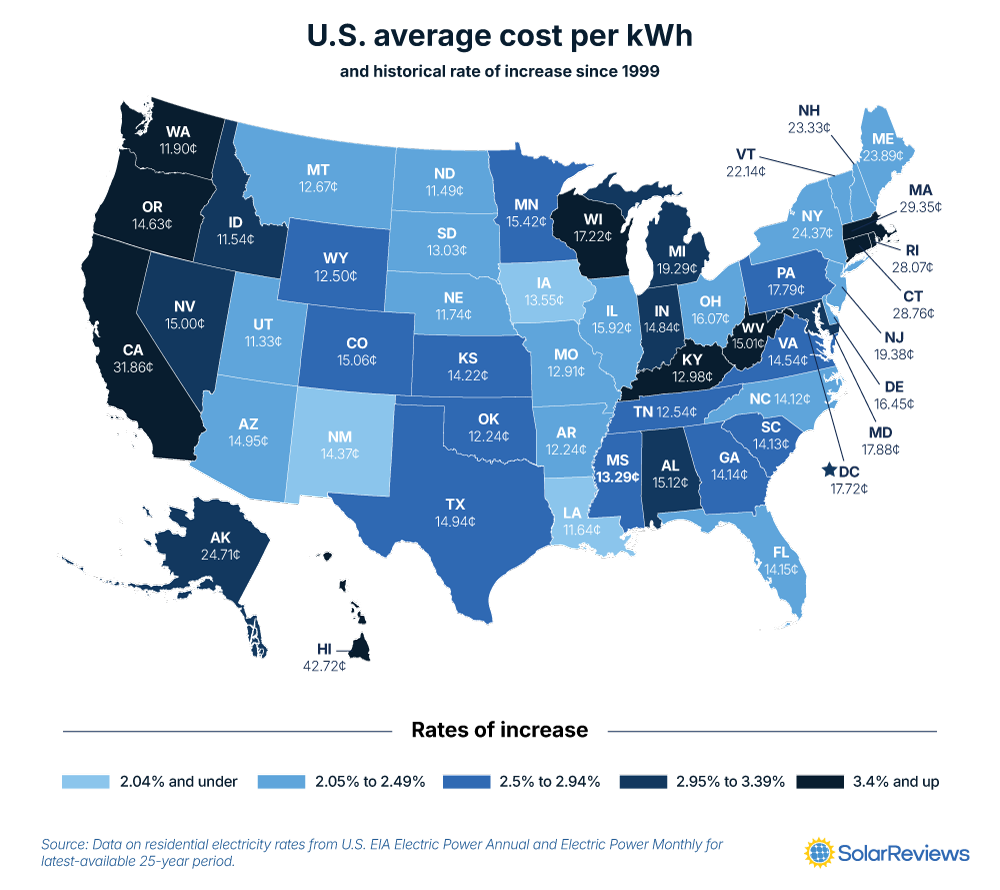
According to the U.S. Energy Information Administration (EIA), electricity prices have increased by an average 2.85% per year in the last 25 years. This rate of increase varies depending on where you live, as some states have experienced higher increases than others.
For example, electricity rates in California have increased by 4.54% on average each year, while prices in Louisiana have increased only 1.94% – displaying that it can all depend on where you live and what the energy policies are like in your area. Regardless, it’s evident that you can expect prices to go up in one way or another.
This means homeowners who don’t go solar will likely pay more for electricity year after year. Solar helps protect against this trend by locking in long-term energy costs.
4 ways solar keeps you safe from rising electric rates
There are four main ways in which installing solar panels to your home can keep you protected from paying higher electricity bills when your utility raises rates:
Energy independence
Solar locks in your electric rate
Net metering
Solar energy reduces stress on the grid
1. Energy independence
When we talk about energy independence, we’re referring to the ability of solar panels to let homeowners generate their own electricity rather than relying solely on the grid. This gives you more control over your home’s energy source – and reduces your dependence on your utility provider.
By producing your own solar power, you’re less affected by utility rate hikes because you’re buying less electricity from the grid. That means more savings and more money staying in your pocket, even as rates go up.
Adding a solar battery can further reduce your reliance on the grid.
Solar batteries allow you to store excess electricity for later use. Instead of sending extra power back to the grid, you can save it for use at night or during times when your panels aren’t producing electricity, like cloudy days or power outages.
2. Solar locks in your electric rate
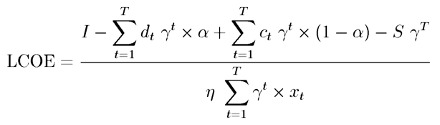
Solar panels lock in your electric rate thanks to the levelized cost of energy (LCOE). This refers to the average cost of the electricity your solar system generates over its entire lifespan (about 25 years). It takes into account the total cost of the system – including installation, maintenance, and any financing – divided by the total amount of electricity it’s expected to produce over its lifespan.
LCOE for residential solar panels ranges from approximately $0.06 to $0.07 per kilowatt-hour (kWh).
If your utility rate is $0.17/kWh and your solar LCOE is $0.06/kWh, you’re effectively paying $0.11 less per kWh for solar energy — and that price stays stable for 25 years.
In other words, solar is like buying 25 years of electricity at today’s price.
3. Net metering
When solar panels produce more energy than a homeowner needs, the excess is sent back to the electric grid. Net metering is the utility bill practice of recording that excess energy generated by a solar installation and applying it to a customer's bill as a credit towards energy drawn from the grid.
However, net metering policies differ in how long credits are allowed to roll over and how much value each credit has. So, how much you can save through net metering differs by state policy and utility regulations.
4. Solar reduces stress on the electrical grid
When more homeowners install solar panels, it significantly reduces the demand on the electrical grid – especially during peak energy usage times like hot summer days. By generating their own electricity, solar-powered homes pull less energy from the grid, which helps balance supply and demand.
The shift not only lessens the strain on grid infrastructure, but also reduces the need for expensive peaker plants to meet high demand. In turn, this can help lower electricity costs for everyone and reduce the risk of power outages or blackouts.
Why do electric rates go up?
Electricity rates can spike due to a combination of economic, environmental, and infrastructure-related issues, including:
Increased fuel costs: Prices for fuels, especially natural gas and petroleum, can increase during periods of higher energy demand or when there are supply issues, like extreme weather events.
Current events: The electrical grid is regulated by federal and state public utility commissions, and major policy changes, political shifts, or global events (like the COVID-19 pandemic) can all impact electricity prices.
Power plant and infrastructure costs: Utilities must invest in maintaining, upgrading, or building new power plants, power lines, or grid equipment. When infrastructure upgrades are made, these costs are passed down to consumers through increased electric rates.
How much money do solar panels actually save?
As of 2026, the average household can save around $125 per month – or $1,500 each year on electricity bills when they install solar panels. However, actual solar panel savings depend on:
Electricity usage
Local utility rates
System size
Net metering policy
Solar incentives and rebates
Some homeowners recoup their solar investment in as little as 5 years. A great way to find out how much solar panels can save your specific home is by using our solar calculator, which is built using real cost estimates from solar installers.
FAQs
Andy Sendy is a well-known and trusted figure within the solar industry with more than 15 years of experience. His video reviews of the leading brands of solar panels and home energy storage batteries are a must-watch each year for both homeowners and solar industry professionals alike. In 2021, an article he wrote about a clause in the Tesla solar panel rental contract caused Tesla to change this clause within days. He was the founder of Sola...
Learn more about Andy Sendy