Find out what solar panels cost in your area
Key takeaways
-
Whole-Home Electrification: Both SPAN and Lumin modernize homes for high-demand loads like EVs and heat pumps, managing power dynamically to avoid costly utility upgrades.
-
Installation & Cost: SPAN replaces your main panel, costing $3,500–$15,000+ installed. Lumin is an add-on module, typically $3,000–$8,000 installed, making it a more budget-friendly retrofit.
-
Control & Integration: SPAN offers comprehensive whole-home circuit control. Lumin focuses on managing 12-18 high-draw circuits, offering local control even without Wi-Fi.
-
Savings Potential: Both panels can save homeowners $50–$300/year on energy bills by optimizing usage, and potentially thousands by preventing a utility service upgrade.
Smart electrical panels are central to modern home energy management. These systems offer real-time, circuit-level energy monitoring and remote control via a smartphone app¹. They are particularly important for homes adding high-demand loads like solar panels, battery storage, EV chargers, and heat pumps².
A smart panel's core function is intelligent load management. It dynamically manages power usage, preventing the need for a full utility service upgrade by keeping your home within its existing service capacity. This can save homeowners a significant amount, as a utility service upgrade can cost $3,000 to $20,000 and involve delays of 3-9 months².
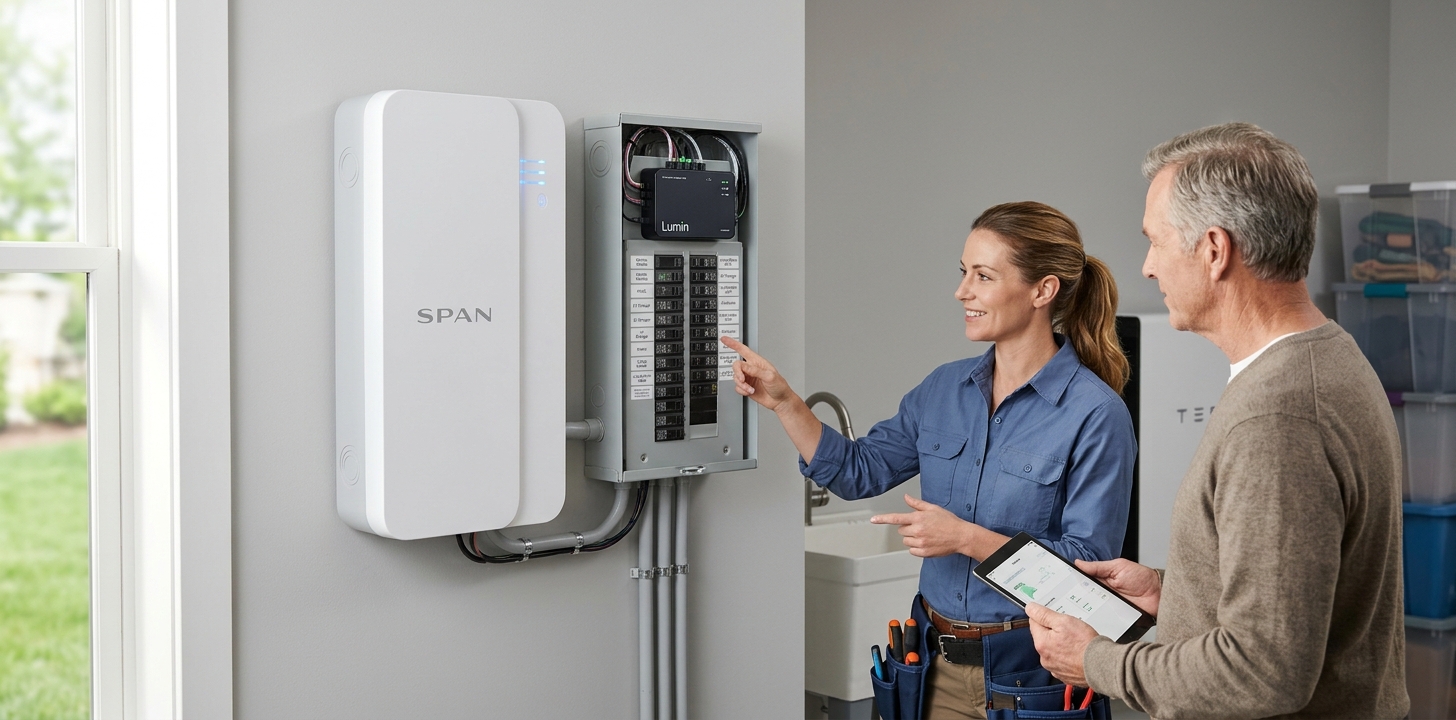
This guide compares two leading smart electrical panels, SPAN and Lumin. We evaluate their features, installation considerations, costs, and overall benefits for whole-home electrification.
SPAN Panel: Whole-Home Control
The SPAN electrical panel is a complete replacement for your existing main electrical panel². It offers software-controlled breakers for every circuit, with models supporting up to 32 or 40 circuits. This provides whole-home visibility, allowing individual monitoring and control of every circuit through its app³.
SPAN integrates deeply with solar, battery storage systems like Tesla Powerwall, Enphase, and SolarEdge, and EV chargers³. It intelligently routes solar power, stores excess in batteries, and manages EV charging alongside other loads¹. For homes with solar, SPAN can work with larger solar arrays without further system upgrades due to its 225-amp rating .⁴
During power outages, SPAN’s "Load Shedding" architecture dynamically sheds non-essential loads. This extends battery life, and homeowners can program their own priority rules. This optimized control can lead to up to 40% more battery life⁵. SPAN also optimizes energy use with time-of-use (TOU) rates by shifting high-load tasks to off-peak hours³. You can learn more about its features in our detailed article, SPAN Panel Overview: The Key to Smart Energy in Your Home.
SPAN Installation and Cost
Installing a SPAN panel is a more involved process since it replaces the entire main panel. Installation often takes 4-8 hours of on-site work and requires 3-5 hours of power-off time³. SPAN is ideal if your existing panel is old, damaged, obsolete (like Federal Pacific or Zinsco), or if you lack sufficient breaker slots².
The hardware MSRP for SPAN starts at $2,550 for the MLO 24 model, with the MAIN 32 at $3,500 and MAIN 40 at $4,100, according to 2026 figures⁵.
Installed costs vary by region:
Southern California: roughly $3,500–$5,500⁶
DFW, Texas: $4,500–$15,000+, with entry-level at $4,500–$6,500, mid-range at $6,500–$9,000, and premium full-home integration at $9,000–$15,000+⁷
Connecticut: $5,500–$8,000 for a typical 200A single-family home³
New England and Texas (via NuWatt Energy): $6,500–$10,000⁸
Additional costs may apply for service-mast replacement ($800–$1,500) or a service upgrade from 100A to 200A ($1,500–$3,500). A bundled service upgrade with SPAN can range from $7,000–$11,000³.
SPAN comes with a 10-year product warranty³. SPAN may require a monthly subscription of $8/month after Year 1 for full app features .
Lumin Smart Panel: Strategic Circuit Management
The Lumin smart panel is an add-on module that works with your existing electrical panel; it does not replace the entire panel². It controls up to 12-18 circuits, focusing on managing high-draw appliances. Lumin provides per-circuit monitoring and automatic load shedding⁸.
Lumin is compatible with any electrical panel and integrates with home batteries from major brands such as Tesla (Powerwall, Powerwall+, Powerwall 3), Enphase, SolarEdge, Generac, and EG4⁸. It optimizes battery usage by reading and responding to the battery's state of charge, shedding lower-priority appliances as the battery depletes⁹. Lumin supports EV chargers and heat pumps without needing a service upgrade by dynamically managing demand within existing capacity².
Like SPAN, Lumin helps save money under time-of-use (TOU) rate plans by enabling automatic control of circuits based on time of day, grid status, or battery capacity. Lumin also offers local control even when Wi-Fi is down. You can read more about this system in our article, Lumin Smart Panel Overview: How It Works And Who It’s For.
Lumin Installation and Cost
Lumin functions as a "bridge solution" for homeowners with a relatively new and functional electrical panel who want smart features without a full replacement⁹. Its installation is less intrusive than a full panel replacement, typically taking 1.5-4 hours. Some sources state 3-4 hours⁸. It installs in half a day without disturbing the main service entrance².
Lumin typically costs $3,000–$8,000 installed, depending on region and source. NuWatt Energy’s 2026 data puts it at $5,000–$8,000, while ElectrifyLogic’s 2026 breakdown estimates around $3,050 ($1,850 hardware + $1,200 labor).
NuWatt Energy states Lumin is lower cost than SPAN, comparing $5,000–$8,000 for Lumin to $6,500–$10,000 for SPAN. Lumin carries a 10-year product warranty, according to 2026 data⁸. A conflicting source states a 5-year warranty (2026 data) .
SPAN vs. Lumin: Side-by-Side Comparison
| Feature/Criterion | SPAN Panel | Lumin Smart Panel | Winner |
|---|---|---|---|
| Panel Type | Full main panel replacement | Add-on module to existing panel² | Lumin (for existing panels) |
| Circuit Control | All circuits (up to 32 or 40) | Up to 12-18 high-draw circuits | SPAN (for comprehensive control) |
| Installation Complexity | More involved (4-8 hours, 3-5 hours power-off) | Less involved (1.5-4 hours) | Lumin |
| Installed Cost (Estimate) | $3,500–$15,000+ (regional variation)⁶⁷ | $3,000–$8,000 (regional variation) | Lumin |
| Solar/Battery Integration | Deep native integration | Compatible with major brands, monitors Powerwall 3 | Tie |
| Outage Management | Dynamic load shedding, up to 40% more battery life⁵ | Automatic load shedding based on battery state⁹ | SPAN (for battery life extension) |
| Warranty | 10 years³ | 10 years⁸ (conflicting: 5 years ) | SPAN (clearer warranty) |
| Subscription Fee | Potentially $8/month after Year 1 | None reported | Lumin |
Overall Cost and Value
Lumin generally has a lower total installed cost than SPAN. NuWatt Energy, for instance, estimates Lumin at $5,000–$8,000 installed, compared to SPAN's $6,500–$10,000⁸. This makes Lumin a more budget-friendly option for homeowners with a functional existing panel .⁹
SPAN's higher cost reflects its full panel replacement and comprehensive circuit-level control. This is a worthwhile investment if your existing panel is old or insufficient², or if you seek total home energy management.
Long-Term Savings and Benefits
Both SPAN and Lumin offer significant long-term savings and benefits, especially for homes undergoing electrification.
One primary long-term saving for both smart panels is the potential to avoid a costly utility service upgrade. This is particularly relevant for homes with 100A or 150A service looking to add new high-demand electric loads like EV chargers, heat pumps, or additional solar. By dynamically managing power, these panels prevent overloads and ensure your home stays within its existing service capacity. Smart panels can pay for themselves by avoiding the cost of a utility service upgrade².
Beyond avoiding upgrades, smart panels provide ongoing energy savings. By optimizing energy consumption and shifting high-load tasks to off-peak hours, homeowners can typically save $50–$300 per year on energy bills. Those with EVs, solar, or battery backup may see higher savings⁷. Real-time monitoring alone can reduce energy usage by approximately 12% .
For more context on smart systems in electrified homes, read Integrating Solar Energy for Home Electrification: A Decision Guide.
Incentives and Tax Credits
As of 2026, the federal 25C tax credit for standalone electrical panel upgrades (up to $600) expired for anything placed in service after 2025⁶.
However, smart panels installed as part of a solar or battery storage system may still qualify for the 30% federal Investment Tax Credit (ITC) . Homeowners should also check for state-specific rebates, such as Michigan's HEAR program, which may cover electrical panel upgrades .
Recommendation
SPAN is the clear winner for homeowners seeking comprehensive whole-home control and deep integration across a full suite of solar, battery, and EV charging components. It is ideal for new constructions or homes with an old, insufficient, or unsafe electrical panel that needs replacement anyway². Its granular circuit control and advanced battery optimization features make it suitable for homeowners committed to maximizing their electrification investments.
Lumin is the stronger choice for homeowners seeking a cost-effective retrofit solution ². It is particularly well-suited for adding smart load management, optimizing battery backup, and managing key high-draw circuits without replacing the entire panel⁹. Lumin is a good option for those on a budget who still want circuit-level control for their most important appliances .
Ultimately, the best choice depends on your existing electrical infrastructure, budget, and the level of control you desire for your electrified home. Both panels offer significant benefits in managing energy and avoiding costly utility upgrades.
Additional Resources
Sources:
SPAN SMART Panel: How the Smart Electrical Panel Makes Solar Energy Work Better at Home, 2026 (solarcellzusa.com)
SPAN vs Lumin Smart Panel: 100A Service Retrofit ROI, Graham Ward, 2026 (electrifylogic.com)
SPAN Smart Panel Installers & Cost Guide (CT, 2026), Tyler Flanagan, 2026 (tjfelectric.com)
SPAN Panels: What They Are & How They Work!, Leo Sharkey, 2026 (jaymoodyhvac.com)
SPAN electrical panel cost: $2,550 MSRP, installed-price guide (2026), 2026 (sheltervolt.com)
SPAN Smart Panel Review: Worth It in 2026?, Helios Energy Global, 2026 (heliosenergyglobal.com)
SPAN Electrical Panel: Cost, Reviews & Energy Efficiency in DFW, Logan Hassinger, 2026 (epicelectrical.com)
Span Vs Lumin Smart Panel (nuwattenergy.com)
Lumin Smart Panel (nuwattenergy.com)
Deana is a Home Improvement Editor with a passion for helping homeowners navigate renovation, repair, and remodeling with confidence. Specializing in roofing, kitchen and bath remodeling, and outdoor living spaces, she combines industry knowledge with a genuine commitment to making complex home projects feel approachable for readers at every stage of their journey. Her path into home improvement media began after several years working alongside ...
Learn more about Deana Barbaro