Updated 2 months ago
Integrating Solar Energy for Home Electrification: A Decision Guide
Written by
Deana Barbaro
Find out what solar panels cost in your area
Key takeaways
-
Cost & Savings: A solar energy system costs $13,962 to $27,924 before incentives¹ , potentially saving $41,000 to $155,000 over 25 years⁵ .
-
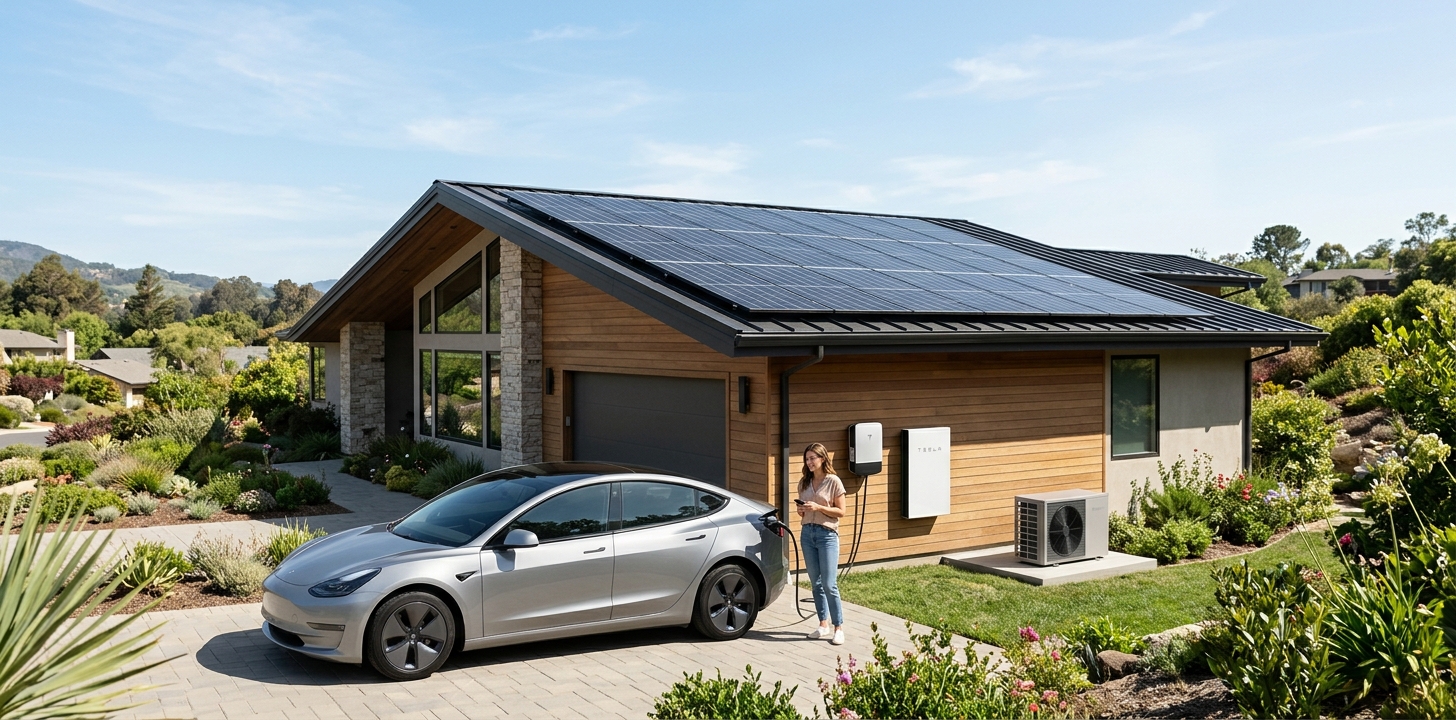
Electrification Focus: Integrate solar with EV charging and heat pumps to maximize savings and reduce grid reliance.
-
Smart Technology: Smart electrical panels and battery storage are crucial for optimizing solar energy with modern electrification needs, especially with time-of-use rates³ .
Homeowners are increasingly looking beyond basic solar panels to create fully electrified, energy-independent homes. This involves integrating solar energy for home power, electric vehicle (EV) charging, and efficient heating and cooling systems like heat pumps. Modern solar solutions focus on smart technology to manage these combined loads efficiently.
This guide outlines a decision framework for planning an integrated solar energy system, focusing on maximizing your investment and reducing reliance on the grid. We will cover typical costs, essential components, and how to size a system that powers your home and electrified appliances.
Understanding Solar Energy System Costs
The upfront cost of installing solar energy for home use is a significant consideration. Solar panel installations typically range from $13,962 to $27,924 in 2026, before any incentives¹ . The national average for a full-service installation is around $20,000 before incentives² .
Most installers price solar systems between $2.00 and $3.00 per watt before incentives, with the average cost per watt at $2.82. A competitive price for standard installations generally falls between $2.50 and $3.00 per watt³ .
⁴
These figures cover the entire solar power system, which includes the solar panels, inverters to convert DC to usable AC, a mounting system, and optional batteries for storage. Solar panels themselves represent only about 12% of the total system cost; the majority covers labor, business operations, and supporting equipment⁴ .
Factors Influencing Your Solar Cost
Several factors affect the final price of your solar energy system:
Energy Needs: Your household's electricity consumption directly determines the system size required.
Roof Characteristics: The size, angle, and condition of your roof can impact installation complexity and cost.
Local Incentives: State and local programs, utility rebates, and net metering policies significantly reduce out-of-pocket costs.
Labor Rates and Permitting Fees: These vary by region. States like California and New York often have higher solar prices, while Arizona, Florida, and Texas tend to be more affordable³ .
Equipment Quality: Premium panels and inverters cost more but offer higher efficiency and longer warranties.
Over 25 years, homeowners with solar panels can save roughly $41,000 to $155,000 on electricity costs⁵ . Most homeowners typically recoup their investment in about 10-12 years⁶ .
Essential Components of a Modern Solar Energy System
A complete solar energy system for home electrification consists of several integrated components:
Solar Panels: These convert sunlight into direct current (DC) electricity. Modern residential panels typically operate in the 20-22% efficiency range. Premium models can exceed 22%, with some reaching 23-24% under Standard Test Conditions (STC)⁷ . Higher efficiency panels generate more power from a smaller footprint, ideal for limited roof space.
Inverters: These devices convert the DC electricity from your solar panels into alternating current (AC) that your home appliances use and the grid accepts. Module-Level Power Electronics (MLPEs), like microinverters or power optimizers, are now standard in US residential systems for rapid shutdown compliance.
Mounting System: This secures the solar panels to your roof or ground.
Battery Storage (Optional but Recommended): Batteries store excess solar electricity for use when the sun isn't shining or during peak utility rates. This is especially important for maximizing savings with solar energy storage and managing time-of-use (TOU) rates. You can learn more about specific types of batteries in our article on lithium-ion solar batteries for home energy storage.
Smart Electrical Panel (Optional but Recommended): Panels like SPAN and Lumin dynamically manage electricity flow from solar, grid, batteries, and high-demand appliances like EV chargers and heat pumps. They can help optimize energy use and potentially avoid costly electrical panel upgrades.
Solar Panel Types and Efficiency
Understanding the different types of solar cells for home use helps in selecting the right panels:
Monocrystalline Panels: Made from a single silicon crystal, these offer the highest efficiency (15-22%) and longest lifespan. N-type monocrystalline panels (TOPCon, HJT) are dominant in new residential installations.
Polycrystalline Panels: These are made from multiple silicon crystals, providing solid performance with generally lower efficiency (15-18%) than monocrystalline panels. They are less common in new installations.
Thin-Film Panels: With efficiency ranges of roughly 10-18%, these are less common for residential rooftops due to their larger space requirements for the same output⁷ .
Solar panels are durable, typically lasting 25-30 years⁵ . Most systems still produce over 80% efficiency after 25 years⁶ . Modern panels degrade slowly, around 0.3-0.5% per year for premium models⁷ .
Consider the long-term degradation rate and warranty when choosing solar panels. Some manufacturers offer warranties up to 40 years.
Sizing Your Solar System for Electrification
A key decision for an integrated solar energy for home system is proper sizing. You need to account for your current electricity use and any planned electrification upgrades, such as an EV or a heat pump.
Powering Your Electric Vehicle (EV)
EV charging significantly increases household electricity demand. An average EV driven 12,000 miles per year uses 3,000-4,500 kWh annually, which is roughly 30-40% of the average US home's total electricity use³ . For example, a Tesla Model Y driven 12,000 miles per year uses approximately 3,600 kWh.
To offset this additional load, you typically need 6-10 more solar panels (assuming 440W panels, producing ~550 kWh/year in New England). Larger vehicles like the Ford F-150 Lightning may require about 10 additional solar panels, while efficient EV sedans might need 4-5³ . For more on panel output, see How much energy does a solar panel produce?.
A typical home combined with an EV charging system usually requires a 12-16 kW solar array, or 27-36 panels. Level 2 (240V, 7-11 kW) EV charging is significantly better for solar integration than Level 1 (120V, 1.4 kW). It allows for faster charging (25-30 miles per hour) and better optimization with solar and battery storage³ . Adding solar and an EV charger may also require an electrical panel upgrade from 100A to 200A, costing $1,500-$3,000. Smart electrical panels can help manage these loads dynamically.
Integrating a Heat Pump
Heat pumps are highly efficient electric heating and cooling systems that also add to your electricity consumption. A heat pump can add 3,000 to 20,000 kWh per year to your household electricity usage, depending on the type, home size, and climate³ .
You typically need to size your solar system 2-3 kW larger to cover heat pump electricity usage. This translates to an additional 8-16 solar panels (440W each in New England), depending on the heat pump type and system³ .
Bundling solar panels and a heat pump can offer substantial savings, potentially $2,000-$5,000 compared to separate installations. Oil-heated homes can save the most by bundling, potentially over $2,000 per year. Payback periods for bundled systems are often 9-15 years³ .
Optimizing Your Integrated System with Smart Technology
Modern solar energy for home systems go beyond just panels. They integrate power generation, storage, and intelligent control.
The Role of Battery Storage and Smart Panels
Battery storage is critical for EV owners, especially with Time-of-Use (TOU) rates, where electricity prices fluctuate by time of day. Under new net metering policies, such as NEM 3.0 in California, homeowners are paid less for exported solar electricity, and export rates also fluctuate. Battery storage allows you to store self-generated solar energy for charging during peak rate periods or overnight, maximizing your return on investment³ .
Smart panels like SPAN and Lumin are key to this optimization. They can dynamically share electrical capacity between solar, EV charging, and other home loads³ . This intelligent management can potentially help you avoid costly electrical panel upgrades by efficiently distributing power.
Pros
-
Maximize self-consumption of solar energy.
-
Reduce reliance on the grid during peak pricing.
-
Provide backup power during outages.
-
Optimize EV charging and heat pump operation.
Cons
-
Adds to initial system cost.
-
Requires careful sizing and integration.
The "Resilience Stack" concept combines solar panels, battery storage, EV charging, and other home electrification technologies to reduce grid dependence. This approach is gaining traction due to growing concerns about grid reliability and extreme weather, making backup power a significant motivator for solar adoption³ .
Incentives and Financial Considerations
The financial landscape for solar energy for home has shifted. The 30% federal residential solar tax credit for homeowner-owned systems expires on December 31, 2025³ .
However, some solar projects now use "tax equity partnerships" or third-party ownership models (leases, PPAs). These allow homeowners to still benefit from federal incentives through lower payments, as the financing company claims the commercial clean energy credit³ .
Current primary incentives include:
State Tax Credits: Many states offer their own tax credits.
Utility Rebates: Local utility companies may provide rebates for solar installations.
Net Metering Programs: These allow you to sell excess solar electricity back to the grid, though policies like California's NEM 3.0 have changed how this works, making battery storage more valuable³ .
Property Tax Exemptions: Some states exempt the added value of solar from property tax assessments.
These state and local incentives vary significantly and can impact your net solar cost by $3,000-$8,000. States like Rhode Island, Massachusetts, and Maine offer strong combined incentive stacks for solar and heat pumps. Automated permitting platforms like SolarAPP+ are also streamlining the installation process in some regions, reducing permit review times³ .
Making Your Decision
Planning an integrated solar energy for home system requires careful consideration. Here is a checklist to guide your decision:
Decision Checklist for Home Electrification with Solar
Assess Your Current & Future Energy Needs:
Review your last 12-24 months of electricity bills.
Factor in any planned electric vehicle purchases (e.g., typical EV uses 3,000-4,500 kWh annually).
Account for future heat pump installations (adds 3,000-20,000 kWh per year).
Evaluate Your Home's Suitability:
Check roof condition, size, and orientation for optimal sun exposure.
Consider ground-mount options if your roof isn't suitable.
Determine if an electrical panel upgrade (from 100A to 200A) is needed for EV charging or a heat pump.
Research Equipment Options:
Compare solar panel efficiency (20-22% is standard, premium up to 24.1%) and warranties.
Look for N-type monocrystalline panels (TOPCon, HJT) for new installations⁷ .
Consider module-level power electronics (microinverters or power optimizers).
Evaluate battery storage options for resilience and TOU rate optimization.
Explore smart electrical panels (e.g., SPAN, Lumin) for energy management.
Understand Costs and Incentives:
Obtain multiple quotes (a competitive price is $2.50-$3.00 per watt before incentives).
Investigate state tax credits, utility rebates, and net metering programs.
Ask installers about third-party ownership models or 'tax equity partnerships' if you are installing after the federal tax credit expired³ .
Choose a Reputable Installer:
Look for experienced installers with strong local references.
Ensure they handle all permitting and interconnection processes.
Inquire about post-installation support and maintenance.
Recommendation: Embrace Integrated Electrification
For homeowners in 2026, investing in an integrated solar energy system that encompasses home power generation, EV charging, and efficient heating/cooling with heat pumps is the most forward-thinking approach. While the direct federal tax credit for homeowners has ended, the long-term savings, energy independence, and environmental benefits remain substantial.
Prioritizing battery storage and smart electrical panels will be key to maximizing your investment, especially given evolving net metering policies and the desire to use more of your self-generated power on-site. This comprehensive strategy not only lowers your utility bills but also positions your home for a more resilient and sustainable future.
Sources:
How Much Do Solar Panels Cost? (2026), 2026 (consumeraffairs.com)
Solar Panel Cost in 2026: Real Prices & What You'll Pay, 2026 (solarinfopath.com)
Solar Power Cost 2026: Real Prices + Tax Credit Deadline, 2026 (a1solarstore.com)
Solar Panel Cost Archives (solar.com)
Are Solar Panels Worth It in 2025? Here’s the Truth, 2026 (energysage.com)
Why Go Solar in 2026? (e2solar.com)
How Efficient Are Solar Panels? 2026 Performance Guide, 2026 (a1solarstore.com)
Deana is a Home Improvement Editor with a passion for helping homeowners navigate renovation, repair, and remodeling with confidence. Specializing in roofing, kitchen and bath remodeling, and outdoor living spaces, she combines industry knowledge with a genuine commitment to making complex home projects feel approachable for readers at every stage of their journey. Her path into home improvement media began after several years working alongside ...
Learn more about Deana Barbaro