Find out what solar panels cost in your area
Key takeaways
-
Environmental Impact: Community solar reduces greenhouse gas emissions and reliance on fossil fuels, with an average household offsetting 5 metric tons of carbon dioxide annually.
-
Air Quality & Resources: These projects eliminate harmful pollutants like sulfur dioxide, improving air quality, and preserve natural resources by reducing fossil fuel extraction.
-
Economic & Social Benefits: Community solar creates local jobs in construction and operations while generating tax revenue for schools and municipal services.
-
Accessibility: It allows renters, apartment dwellers, and those with unsuitable roofs to access solar energy.
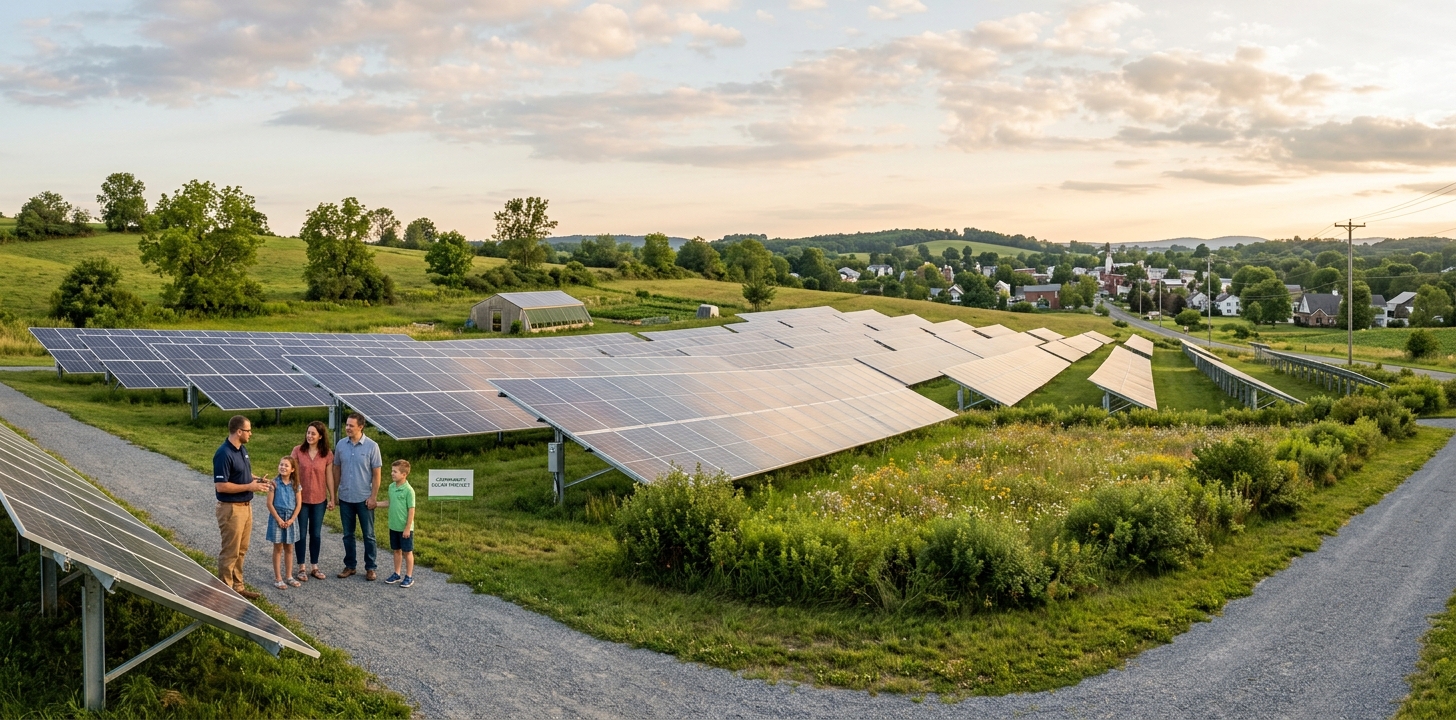
Subscribing to a community solar project offers a direct path to supporting clean energy, even for those unable to install rooftop panels. This approach allows multiple customers to share a local solar installation, receiving credits on their electricity bills for the power generated. It provides solar access to renters, apartment dwellers, and homeowners with unsuitable roofs or financial constraints¹. Beyond the personal financial benefits, community solar delivers substantial environmental and community-wide advantages.
Environmental Impact: Reducing Emissions and Preserving Resources
Community solar directly contributes to a cleaner environment by supporting renewable electricity generation. The power produced by these projects feeds directly into the local grid². This reduces the overall reliance on fossil fuels, which in turn leads to less pollution and fewer greenhouse gas emissions.¹
Participants actively help combat climate change by reducing greenhouse gas emissions³. For context, the average American household offsets approximately 5 metric tons of carbon dioxide emissions annually by switching to solar energy⁴. Switching to solar energy replaces traditional electricity and saves about 9,000 pounds of carbon pollution per average American home annually⁵.
Improved Air Quality and Natural Resource Preservation
Solar energy produces no harmful pollutants, such as sulfur dioxide and nitrogen oxides, which improves air quality and reduces the risk of respiratory illnesses. By reducing the need for fossil fuel power plants, community solar directly improves local air quality³.
Furthermore, community solar projects help preserve vital natural resources like land and water. Fossil fuel extraction and processing are resource-intensive and often lead to habitat destruction and water pollution. Shifting to solar power lessens these impacts. Many community solar projects are developed on sites like landfills or brownfields, repurposing disturbed land and minimizing new environmental impact⁶. Careful planning ensures ecological disruption is minimized and local wildlife can be supported³.
The US community solar sector surpassed 10 gigawatts (GWdc) of cumulative national installations as of late 2025⁷. This growth reflects a significant shift towards accessible clean energy.
Economic and Community Development
Community solar projects contribute to local economies beyond just providing clean energy. They create jobs across various sectors, including construction, engineering, operations, and maintenance¹. These are local jobs, supporting residents within the communities where projects are built.
Beyond job creation, community solar also generates new tax revenue. This revenue can then be used to support local schools and essential municipal services, providing a tangible benefit to the broader community⁸.
Industry Growth and Goals
The community solar industry is expanding, making access to these benefits more widespread. The Department of Energy's National Community Solar Partnership (NCSP) aimed for community solar to power 5 million US households and create $1 billion in energy savings by 2025. The industry committed to developing 20 GW of capacity by 2025 to align with this goal.
While the market saw a 25% contraction in 2025, national installed capacity was projected to rebound with 12% growth in 2026⁷. More recently, in Q1 2026, the market installed 247 MWdc, a 4% decline year-over-year. However, the national community solar market is now projected to grow by 1% in 2026, reaching approximately 1.7 GWdc.
Considerations for Subscribers
While the benefits are clear, potential subscribers should understand how these programs operate. Community solar is not yet available in all states or utility territories, though its availability continues to grow⁶. Participation is often managed through partnerships with utilities or third-party developers¹.
Potential subscribers should carefully review contract lengths, cancellation policies, and any associated fees. Some programs involve long-term commitments, while others offer more flexible terms. The savings from community solar can fluctuate, depending on the project's energy production and changes in utility rates⁶. There might be months where payments to the community solar company exceed direct utility payments⁹. For a comparison of options, you can read more about specific providers like Nexamp community solar.
Pros
-
Access to solar energy without home installation
-
Reduced greenhouse gas emissions and air pollution
-
Preservation of natural resources and wildlife habitats
-
Creation of local jobs and tax revenue
-
Potential for utility bill savings
Cons
-
Not available in all areas
-
Savings can fluctuate
-
No direct increase in home property value
-
Ineligibility for some direct homeowner solar incentives
-
Utility bills may seem more complex initially
Unlike direct rooftop solar installations, community solar does not directly increase a home's property value because the solar equipment is not physically attached to the residence². Additionally, subscribers are typically not eligible for certain solar rebates and tax credits designed for system owners⁶. However, developers may pass on indirect benefits from their own tax credits as additional savings, such as the 10% increase on the clean electricity investment tax credit for projects in low-income areas. For a broader look at available financial supports, explore various solar incentives.
Moving with a community solar subscription depends on the program's portability and availability in a new location⁶. The addition of solar credits and a separate bill from the community solar provider can also make utility bills seem more complex at first glance⁹. However, the overall benefits to the environment and local community often outweigh these administrative considerations for many.
The Broader Value of Community Solar
Community solar offers a compelling solution for homeowners and renters alike to access clean energy and contribute to environmental protection and local economic growth. It enables a wider segment of the population to participate in the renewable energy transition, driving down pollution and fostering sustainable development. The decision on whether "what is community solar worth it" ultimately depends on an individual's priorities and the availability of programs in their area, but the collective benefits are clear.
Sources:
Community Solar, 2026 (energy.gov)
Community Solar Programs: How Do They Work in 2026? (energy.ecoflow.com)
Environmental Impacts of Community Solar Farms, Renewables Worldwide, 2023 (renewablesworldwide.org)
How Does Community Solar Benefit the Environment?, Christie Young, 2023 (site.solstice.us)
Measuring the Environmental Impacts of Community Solar (solarlandscape.com)
The Pros And Cons Of Community Solar Farms (surfcleanenergy.com)
US community solar surpasses 10 GW milestone in 2025 despite tightening market conditions, according to Wood Mackenzie, 2026 (woodmac.com)
Community Solar Pros and Cons: Exploring the Criticisms, Admin, 2026 (nautilussolar.com)
Community Solar Savings By Season: The Full Breakdown, 2023 (energysage.com)
Deana is a Home Improvement Editor with a passion for helping homeowners navigate renovation, repair, and remodeling with confidence. Specializing in roofing, kitchen and bath remodeling, and outdoor living spaces, she combines industry knowledge with a genuine commitment to making complex home projects feel approachable for readers at every stage of their journey. Her path into home improvement media began after several years working alongside ...
Learn more about Deana Barbaro