Find out what solar panels cost in your area
Key takeaways
-
Climate Impact: Solar water heater efficiency varies significantly by US climate, with optimal performance in warmer regions.
-
System Types: Passive systems suit warm, non-freezing areas, while active systems with freeze protection are better for colder climates.
-
Energy Savings: Homeowners can expect 50-80% reductions in water heating costs, saving $150-$450 annually depending on location¹.
-
Technology Choice: Evacuated tube collectors excel in cold weather, while flat-plate collectors are efficient in moderate to warm conditions.
Water heating accounts for a significant portion of a typical US home's energy consumption, often ranking as the second-largest energy expense after heating and cooling, consuming 18-20% of total energy¹.
Solar water heaters convert solar energy into heat, achieving up to 80% efficiency in this conversion, which is substantially higher than the 20% typical for photovoltaic (PV) panels converting sunlight into electricity².
This high conversion rate directly translates into significant energy savings for homeowners. However, the specific design and technology choices become critical for maximizing these benefits in diverse climates.
Types of Solar Water Heater Systems and Their Climate Suitability
Solar water heating systems broadly fall into two categories: passive and active. Each type has distinct operational mechanisms and is best suited for particular climate zones. The choice between them significantly impacts efficiency and system longevity, especially where freezing temperatures are a concern.
Passive Systems: Simplicity for Warm Climates
Passive solar water heaters operate without electric pumps, relying on natural convection to circulate heated water from collectors to a storage tank. They are generally more affordable and simpler to install but are less efficient than active systems. These systems are best suited for warm climates where freezing temperatures are rare or nonexistent¹.
Two common passive system types exist:
Integral Collector Storage (ICS) Systems: Also known as "batch" or "breadbox" heaters, these systems combine the collector and storage tank into a single unit. ICS systems are the cheapest and least efficient solar water heating option and are only viable in areas consistently free of freezing temperatures.
Thermosiphon Systems: These systems operate on the principle that heated water rises. Solar-heated water in a flat-plate collector ascends into an insulated storage tank positioned higher than the collector, while colder water from the bottom of the tank flows into the collector for heating. A key consideration for thermosiphon systems is the aesthetic impact of having the storage tank elevated on the roof¹.
For homeowners in regions with any risk of freezing, passive solar water heating systems, especially ICS, pose a significant risk of damage and may not be a practical choice due to their inherent lack of freeze protection.
Active Systems: Versatility for Varied Climates
Active solar water heaters utilize electric pumps to circulate either household water or a heat-transfer fluid through the solar collectors. These systems are typically more expensive than passive options due to the inclusion of pumps and controls¹, but they offer greater efficiency and flexibility for different climate zones.
Active systems are further divided into two primary types:
Direct Circulation Systems (Open-Loop): These systems pump potable household water directly through the solar collectors and back into the storage tank. Direct systems are highly efficient because they avoid heat loss associated with a heat exchange process and prevent nighttime heat loss from water stored on the roof. They are most suitable for climates where freezing is rare, such as the central and southern areas of Florida and other non-freezing sunbelt regions of the US. Freeze protection in direct systems often involves circulating warm tank water through the collector, which can lead to significant energy loss in colder climates or during power outages¹.
Indirect Circulation Systems (Closed-Loop): Indirect systems circulate a non-freezing heat-transfer fluid through the collectors and a heat exchanger, which then heats the potable water in the storage tank. The use of antifreeze in these systems makes them suitable for colder climates. This is the most common distribution method for solar hot water heating.
Drain-back Systems: A specialized type of indirect system, drain-back systems are specifically designed for climates with frequent freezing. When the pump is off, the fluid automatically drains back into a reservoir, preventing freezing within the collector and pipes¹.
Solar Collector Technology and Climate Performance
The type of solar collector used is a critical determinant of a solar water heater's performance, particularly in different US climates. There are three main types of collectors, each with distinct characteristics.
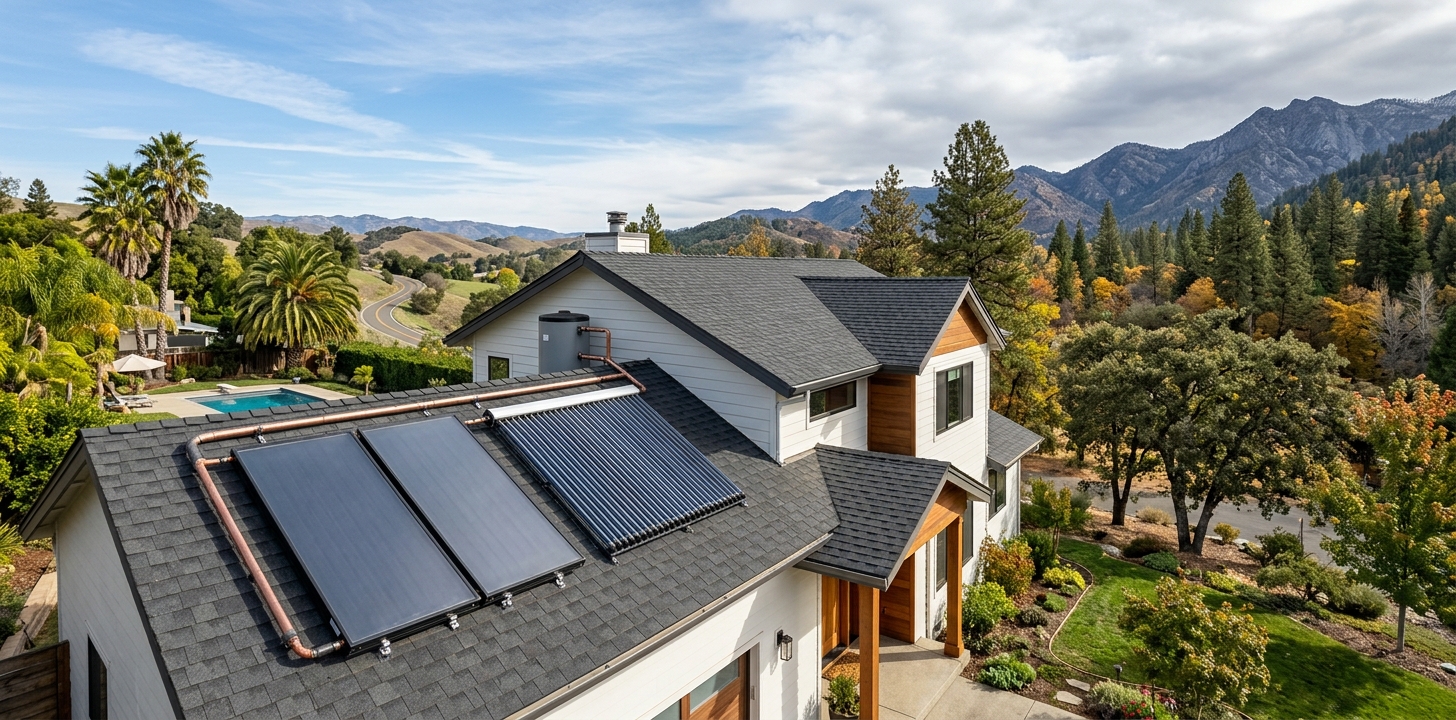
Flat-plate collectors are common in the US and operate more efficiently in summer. Evacuated tube collectors are the most efficient collector type for extremely cold environments but also the most expensive. Solar collectors consist of glass or plastic sheets, a dark absorber plate, and water pipes with insulation. Evacuated tube collectors feature rows of glass tubes with metal pipes and fins, using a vacuum to minimize heat loss¹.
Energy Savings and Performance Across US Regions
Solar water heaters can significantly reduce a home's water heating energy consumption, with savings ranging from 50-80% depending on the climate zone¹. This reduction translates directly into annual cost savings for homeowners.
In hot, sunny regions like Arizona, California, and Texas, homeowners often achieve 70-80% reductions in water heating energy, potentially saving $300-$450 per year. Even in colder Northeast or Midwest climates, typical savings range from 50-60%, amounting to $150-$250 annually. A standard residential setup, such as two 4x8 ft flat-plate collectors or a 30-tube evacuated array, can generate 40,000-50,000 BTU per sunny day (12-15 kWh of heat), sufficient for most family hot water needs¹.
The Solar Uniform Energy Factor (SUEF) is a metric used to evaluate the overall efficiency of solar water heaters; higher SUEF values indicate greater efficiency. For context, solar water heaters generally rank second in efficiency behind heat pump water heaters, with UEF ratings typically between 2.0-3.0, though performance varies significantly by geography and weather. Heat pump water heaters have UEF ratings of 3.5-4.5+³.
Regional Performance Breakdown
Southwest US: This region consistently shows excellent performance for solar water heaters, with SUEF ratings typically between 2.5-3.0 year-round.
Southeast US: Solar water heaters exhibit good performance in the Southeast, generally achieving UEF ratings of 2.0-2.5.
Northern States: Performance in Northern states is moderate, often necessitating a backup heating system to supplement solar hot water production³.
Solar water heating systems are typically designed to meet 40-70% of a home's water heating load. A conventional backup heater remains necessary to cover peak demand or during periods of extended cloudiness⁴. To learn more about solar heating options for your home, including how active and passive systems differ, consider reading Solar heating systems and the art of minimizing electricity bills.
Cost and Incentives for Solar Water Heaters
The average cost to install a solar water heater in the US ranges from $3,000 to $12,000, with an average around $3,706⁵. Another source indicates a range of $3,000 to $9,000 in 2026 for solar water heater installation³.
Current Incentives Landscape (2026)
The federal incentive landscape for solar water heaters has shifted. The Residential Clean Energy Credit (Section 25D) for solar water heaters ended for systems placed in service after December 31, 2025. Therefore, for 2026, the direct federal tax credit for homeowners installing solar water heaters is 0%⁶.
However, other federal programs may offer indirect benefits. The High-Efficiency Electric Home Rebate Act (HEEHRA) provides point-of-sale discounts for heat pump water heaters up to $1,750, with a total household limit of $14,000, for households earning less than 150% of the Area Median Income (AMI). While primarily for heat pump water heaters, solar water heaters may qualify for HEEHRA if they are part of a broader energy-efficient home upgrade⁶.
For commercial projects, including those utilizing Power Purchase Agreements (PPAs), the commercial/PPA (§48E) solar investment tax credit (ITC) transitioned into a technology-neutral credit in 2025. To qualify for the full 30% commercial ITC rate in 2026, projects over 1MW must meet prevailing wage and apprenticeship requirements and "Begin Construction" before July 4, 2026⁶.
Homeowners should also investigate state and local utility rebates, as some municipal utilities continue to offer incentives ranging from $500-$2,000. To be eligible for any incentives, solar water heaters must be certified by the Solar Rating and Certification Corporation (SRCC) or a comparable state-endorsed entity⁶. The ICC-SRCC OG-300 certification program is widely recognized in North America for ensuring compliance with safety, durability, minimum performance, and providing objective energy ratings for nearly 200 locations².
Maintenance and Lifespan
Solar hot water heaters are considered low-maintenance systems. The expected lifespan of a solar hot water system ranges from 15-20 years, with collectors potentially lasting up to 30 years. Some sources suggest these systems can last 20 years or longer with proper care. Regular maintenance, such as flushing storage tanks annually or every six months to prevent sediment buildup, helps ensure longevity and optimal performance⁴. For additional information on different solar water heater types and their overall value, consult Solar water heaters: Are they worth the cost?.
Pros
-
Significant reduction in water heating energy consumption (50-80%)¹
-
Long system lifespan, with collectors potentially lasting up to 30 years⁴
-
High solar energy conversion efficiency (up to 80%) compared to PV panels²
-
Reduced carbon footprint
Cons
-
Higher upfront installation cost compared to conventional water heaters
-
Performance varies significantly by climate, requiring backup heating in colder regions
-
Federal homeowner tax credits for new installations ended after 2025⁶
-
Aesthetic considerations, especially for thermosiphon systems with elevated tanks
Sources:
Solar Water Heaters 101: Types, Pros/Cons, Sizing & How They Work | SolarPoweredWaterHeaters Solar Water Heaters, Reviewed & Explained (solarpoweredwaterheaters.com)
Solar powered water heaters. A comprehensive guide to their value and efficiency (pvcase.com)
Most Energy Efficient Water Heater: Complete 2025 Guide & Rankings, 2026 (solartechonline.com)
How Do Solar Water Heaters Work? (2026), 2026 (consumeraffairs.com)
How much does solar water heater cost, angi.com (angi.com)
Solar Hot Water Heater: A Complete Guide for 2025 (nrgcleanpower.com)
Deana is a Home Improvement Editor with a passion for helping homeowners navigate renovation, repair, and remodeling with confidence. Specializing in roofing, kitchen and bath remodeling, and outdoor living spaces, she combines industry knowledge with a genuine commitment to making complex home projects feel approachable for readers at every stage of their journey. Her path into home improvement media began after several years working alongside ...
Learn more about Deana Barbaro