Find out what solar panels cost in your area
Key takeaways
-
Grid stability: Texas avoided conservation alerts during 2026's extreme heat, a marked improvement from previous years¹.
-
Renewable growth: Utility-scale battery storage capacity reached 13.9 GW in early 2026, nearly doubling from 2025².
-
Solar impact: Solar's share of ERCOT generation has grown rapidly, and EIA forecasts utility-scale solar generation to exceed coal generation on an annual basis for the first time in 2026³.
-
Demand absorption: ERCOT set a new peak-demand record of approximately 91.1 GW on July 22, 2026, while avoiding emergency conditions⁷.
A September 5, 2026, CleanTechnica article highlighted a significant shift in Texas's grid reliability. The Electric Reliability Council of Texas (ERCOT) maintained stable power flow during extreme heat in 2026 without issuing conservation alerts¹. This marks a notable improvement over previous years. Growth in renewable generation and battery storage contributed to this performance.
This year's performance contrasts sharply with 2023, when ERCOT issued six Conservation Appeals during extreme hot weather in late August. Between 2008 and 2022, ERCOT issued nearly 50 such appeals¹. The 2026 results indicate a maturing grid capable of handling higher demand under challenging conditions.
Surging Battery Storage Capacity
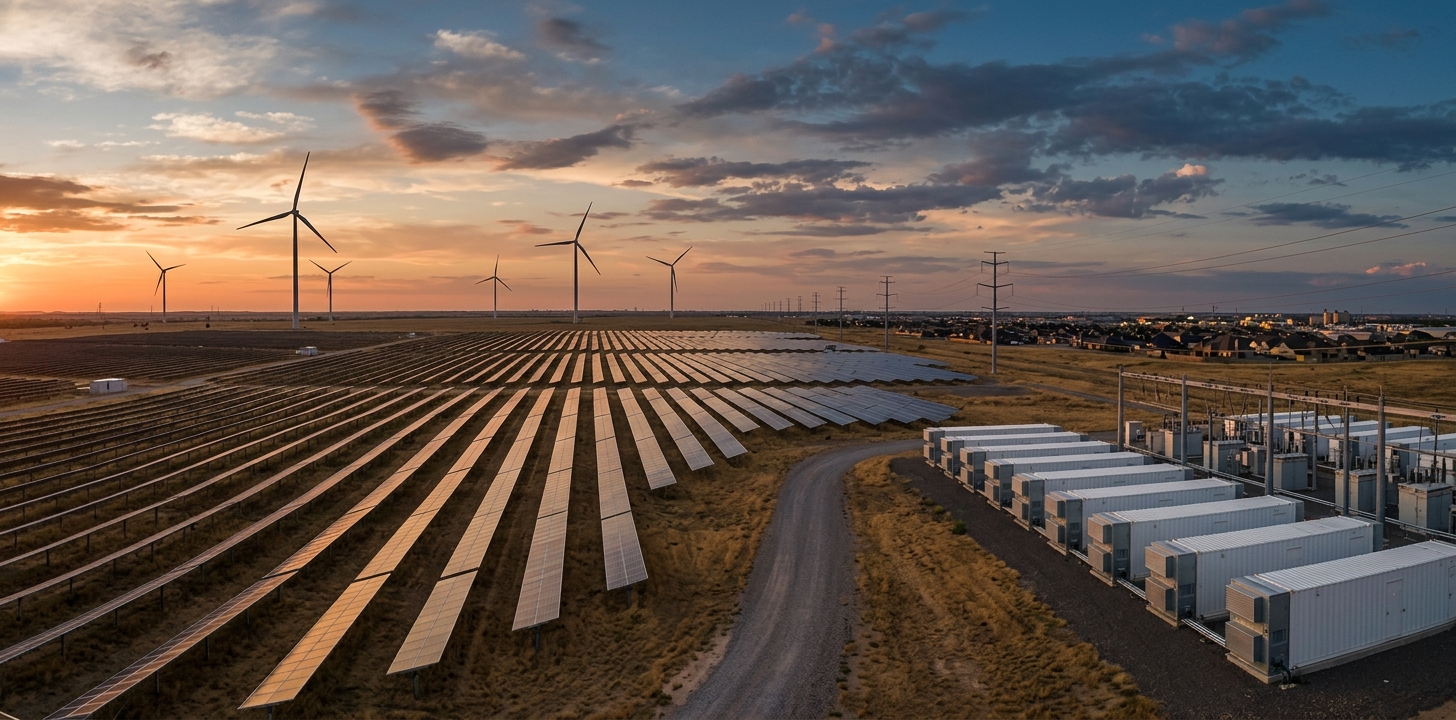
Texas has rapidly expanded its battery storage capabilities, becoming a national leader. At the start of 2026, utility-scale battery storage capacity reached 13.9 GW, almost doubling the 7.8 GW available at the beginning of 2025. By March 2026, ERCOT's grid-scale battery storage capacity hit 14 GW, surpassing California to make Texas the largest storage market in the nation².
The U.S. Energy Information Administration (EIA) projects ERCOT battery capacity to reach 37 GW by the end of 2027³. Texas is expected to contribute over half of the 24 GW of new battery capacity planned nationwide in 2026².
Battery storage systems are crucial for grid stability, allowing excess renewable energy generated during off-peak hours to be stored and then discharged during periods of high demand, like evening peaks.
The Inflation Reduction Act of 2022 has played a role in accelerating battery storage installations. The Inflation Reduction Act expanded federal investment tax-credit eligibility to qualifying standalone energy-storage projects. ERCOT's market design, known for price volatility, has also encouraged the development of battery energy storage systems, making them a critical component of grid reliability⁴.
Record Solar and Wind Contributions
Solar power has become a significant contributor to Texas's energy mix. From April 2025 to March 2026, solar accounted for nearly 12% of the state's electricity, mostly from utility-scale installations⁵. Solar's share of ERCOT generation has grown rapidly, and EIA forecasts utility-scale solar generation to exceed coal generation on an annual basis for the first time in 2026³.
Solar generation reached a record 34.427 GW on May 13, 2026, and nearly 35.425 GW on July 9, 2026. All renewable resources together set a generation record of 52 GW on May 14, 2026⁶.
Throughout 2025, solar and battery storage were responsible for nearly all capacity additions to the Texas grid². In the first quarter of 2026, these two sources constituted 91% of all new grid capacity added in the U.S.⁶. This trend highlights a clear shift in the energy landscape.
Navigating Record Demand Without Alerts
Despite an "especially hot summer" in 2026, ERCOT avoided issuing any Conservation Appeals throughout the season¹. This achievement came even as Texas's population grew and large industrial consumers, like data centers and cryptocurrency mining operations, rapidly expanded. Overall electricity demand in the ERCOT footprint is projected to grow 14% in 2026².
On July 22, 2026, extreme Texas heat pushed ERCOT grid demand past 91 GW for the first time, with unofficial real-time figures peaking around 91,300 MW. This shattered the previous official record of 85,508 MW set in August 2023. Yet, during this peak, the grid operated under normal conditions with substantial reserves. Wholesale prices remained well below the cap, and no calls for conservation were made⁷. ERCOT absorbed this new all-time demand record without initiating emergency operations.
Pros
-
Reduced reliance on traditional fossil fuel sources during peak demand.
-
Increased grid stability and resilience, even during extreme weather.
-
Lower wholesale electricity prices due to abundant renewable supply and battery discharge.
Cons
-
Intermittency of solar and wind requires robust storage solutions.
-
Significant upfront investment needed for large-scale renewable and storage infrastructure.
During the July 22nd peak demand, solar provided approximately one-third of the generation. Real-time prices hovered around $29 per megawatt-hour⁸. Batteries exceeded 10 GW discharge seven times, with five of these instances occurring in July 2026 alone. While natural gas remained the largest single contributor, solar provided strong support during daylight hours, with wind and storage filling gaps⁷.
Strategic Advantage of Renewables and Storage
The growth of renewables and storage has provided Texas with more dispatchable resources within the state. This is crucial given the historically "islanded" nature of the Texas grid, which limits power-sharing with neighboring states. Improved grid stability and increased solar generation allow batteries to be charged during the day with excess solar power. They then discharge during evening peaks, helping to suppress prices and maintain reserves⁷.
Energy analysts attribute Texas's improved grid performance to record-breaking levels of renewable energy generation and battery storage discharges. At times in 2026, solar supplied more than one-third of ERCOT generation, while peak-use prices hovered around $46 per megawatt-hour. Compared to other U.S. power regions, ERCOT navigated a mid-July 2026 heat wave and demand record without emergency actions or price spikes. This difference is largely due to its resource mix, including "lots of solar and batteries"⁸.
Sources:
Renewable Energy And Storage Solve Massive Grid Problem In US, Tina Casey, 2026 (cleantechnica.com)
Texas C&I Battery Storage 2026: Cut 4CP Costs by 40% with ITC Still Active, 2026 (mate-solar.com)
Equinor just brought its biggest US battery online in Texas, Michelle Lewis, 2026 (electrek.co)
ERCOT Energy Storage 2026, $139.6M es Volta Financing, Erhan Eren, 2026 (enkiai.com)
Texas Electricity Generation Mix 2026 | Low-Carbon Power Data, 2026 (lowcarbonpower.org)
6 Records Solar & Storage Have Crushed in the First Half of 2026, Guest Contributor (cleantechnica.com)
Texas ERCOT Grid Holds Beyond 91 Gigawatts in Heat Wave - At What Cost?, Clark Savage, 2026 (energynewsbeat.co)
Extreme heat is turning solar, batteries and load flexibility into the new capacity test for data center growth, 2026 (marketscale.com)
Will is a Home Improvement Editor with a passion for helping homeowners make confident, well-informed decisions about their homes. He specializes in reviewing and refining content covering home renovations, solar energy, roofing, HVAC, insulation, windows, flooring, plumbing, electrical systems, and other key areas of residential improvement. With a strong background in research and technical writing, Will is committed to ensuring every article ...
Learn more about Will Anning