Updated 5 months ago
ICON by VOLTAIC review: A roof-first solar roof for premium homes
Written by
Eric Whitehead
Find out what solar panels cost in your area
Solar roofs tend to get discussed as if they all belong in one neat bucket. They do not. Some are essentially solar equipment made to look more attractive. Some are asphalt-adjacent products designed to fit into mainstream roofing workflows. Others are true roof-integrated systems built around the idea that the roof itself should remain the primary product, with solar embedded into that roofing logic. That distinction is easy to miss in marketing photos, but it matters once you start comparing materials, installation methods, aesthetics, climate fit, and long-term roofing behavior.
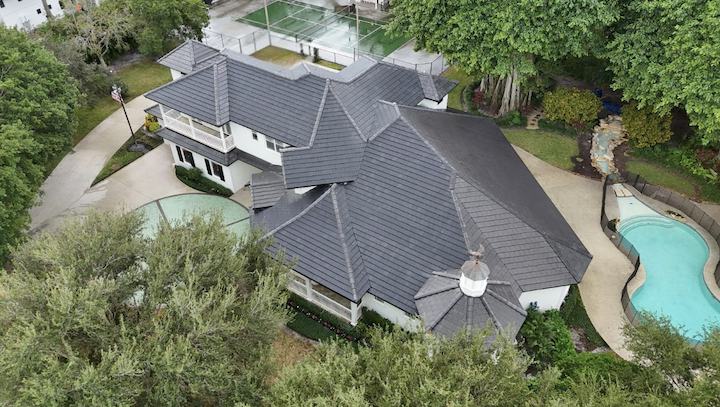
That is why ICON by VOLTAIC is worth a closer look. Based on VOLTAIC’s current public materials, ICON is an integrated concrete solar roof tile system built around a ventilated, sealed roof assembly rather than a direct-to-deck solar layer. VOLTAIC emphasizes concrete tile construction, architectural continuity, roof-first installation logic, and thermal behavior in demanding climates. On paper, that puts ICON in a different lane than many products consumers casually lump into the same “solar roof” conversation.
What ICON actually is
ICON is not a conventional rack-mounted solar system, and it is not an asphalt solar shingle. VOLTAIC describes it as a premium concrete tile roof with integrated photovoltaic laminates, embedded wiring, and string-inverter-based system architecture. The company’s current technical materials list a maximum power output of 17.5 watts per tile, cell efficiency above 21.6%, a power temperature coefficient of -0.27% per degree Celsius, and about 1,540 watts per roofing square. Those numbers do not automatically make ICON superior to every competitor, but they do make clear how VOLTAIC wants the product understood: as a serious roof-integrated system, not simply a prettier alternative to solar panels.
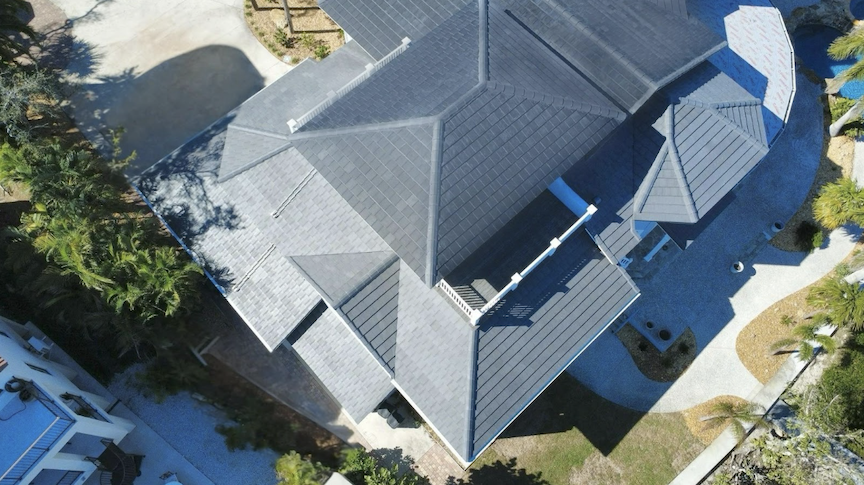 ICON by VOLTAIC roof detail showing the tile field and integrated patterning.
The physical and thermal design are central to that story. VOLTAIC says ICON uses a ventilated roof assembly with rear air space and a double-batten installation method that creates passive airflow beneath the tiles. The company also leans heavily on the thermal mass of concrete, arguing that the roof system is designed to limit heat buildup and support more consistent real-world performance in hot climates. That framing is notable because many solar-roof discussions still focus first on looks and only second on how the roof behaves under sustained field conditions.
Why the market may be misunderstanding it
The simplest reason ICON may be misunderstood is that consumers often ask the wrong comparison question. They ask, “How does this compare to regular solar panels?” That is a fair question, but it is not always the most useful one. For many buyers considering a product like ICON, the real comparison is closer to, “How does this compare to doing a premium roof replacement and a separate solar project at the same time?” That shift in framing does not make ICON inexpensive, but it does place it in a more realistic competitive set. Solar roof products are premium purchases, and standard rooftop solar usually wins on raw cost and payback.
ICON also appears to be targeted more narrowly than some of its rivals, and that is probably a strength rather than a weakness. VOLTAIC’s public positioning points toward premium homes, design-sensitive projects, tile-roof aesthetics, and demanding climates where wind, fire, hail, and heat are part of the buying decision. The company highlights HVHZ acceptance, Class A fire messaging, Class 4 impact resistance, and wind performance up to 160 mph in its published technical materials. Whether every homeowner will value those traits equally is another question, but the product clearly is not being presented as a mass-market answer for every asphalt-roof home in America.
How ICON differs from Tesla Solar Roof
Tesla Solar Roof remains the biggest name in the category. Tesla describes Solar Roof as a fully integrated system made up of glass solar tiles and steel roofing tiles, bundled with Powerwall for backup and energy storage. Tesla’s advantage is obvious: brand recognition, ecosystem appeal, and a consumer-friendly shorthand for the whole category. If many homeowners have heard of only one solar roof, it is usually Tesla.
But Tesla and ICON are not solving the same problem in the same way. Tesla’s product is easier to understand as a branded energy ecosystem with roofing attached. ICON is easier to understand as a roofing-first product with solar built in. Tesla leads with its integrated energy story; VOLTAIC leads with roof assembly, material logic, and climate-specific performance framing. That does not automatically make ICON better, but it does suggest that some homeowners comparing the two as direct substitutes may be flattening important differences.
How ICON differs from GAF Timberline Solar
GAF Timberline Solar is arguably the most mainstream roofing-company entry in the category. GAF says its Timberline Solar ES 2 system functions like a traditional asphalt shingle, installs directly alongside its Timberline shingles, and can be installed by one crew. GAF also markets the product as the world’s first nailable solar shingle and repeatedly frames it as a smart option when a homeowner is already planning a new asphalt roof. That is a very different entry point from VOLTAIC’s.
That difference matters. GAF is trying to make solar roofing feel familiar to the huge asphalt-shingle market. ICON is not. ICON appears aimed at homeowners who already care about premium roof materials, tile aesthetics, and a more substantial roof-integrated solution. In that sense, GAF may be more accessible, but ICON may be more differentiated. A homeowner looking for the most natural solar extension of an asphalt roof may lean one way; a homeowner focused on premium tile architecture and demanding climate performance may lean another.
How ICON differs from CertainTeed Solstice Shingle
CertainTeed’s Solstice Shingle also sits closer to the mainstream shingle conversation. CertainTeed describes it as a solar roofing product that mimics traditional asphalt shingles and installs using standard roofing practices. That pitch is easy for homeowners to understand: cleaner-looking solar without leaving the familiar world of asphalt roofing.
ICON, again, is not really making that pitch. It is making a more specific one: premium concrete tile, integrated photovoltaic function, roof-first installation logic, and stronger emphasis on architectural continuity and high-demand roof conditions. That narrower identity may limit the immediate addressable market, but it also makes the product easier to place conceptually once you stop trying to compare every solar roof product as though it were merely a different flavor of shingle.
Who should seriously consider ICON
Based on the company’s current materials, ICON looks most compelling for homeowners who are already replacing a roof, already drawn to a premium look, or already resistant to the visual compromise of rack-mounted panels. It also looks especially relevant in coastal, hurricane-prone, high-heat, or architecturally sensitive markets where roof performance and appearance are both central to the purchase. It also aligns well with buyers who want an all-in-one solar roof that looks like a luxury concrete tile roof and are willing to pay a premium for that integration.
Just as important, ICON probably is not the right answer for everyone. Homeowners who care mainly about lowest cost and fastest payback will usually be better served by conventional rooftop solar. Buyers with standard asphalt roofs and little concern about visible panels may also find more practical options elsewhere. That is not a knock on ICON. It is part of what makes the product easier to take seriously: it appears to have a defined use case rather than a vague promise to be all things to all buyers.
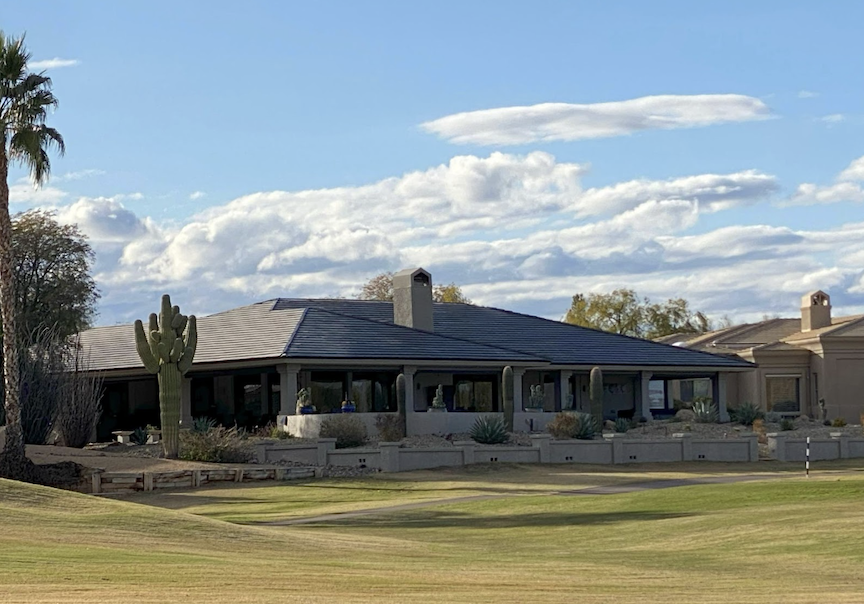
Installed ICON by VOLTAIC roof — Rio Verde, Arizona.
What could hold ICON back
If ICON is misunderstood, the reason may have less to do with product weakness than with market education. It asks consumers to understand a more nuanced value proposition than “save money with solar.” It asks them to think about the roof as a system, about materials, about climate, about architecture, and about the difference between a solar product attached to a roof and a roof designed to generate electricity. That is a harder conversation to win, especially in a market where simpler solar messages have dominated for years.
That challenge is also the opportunity. The strongest case for ICON is not that it has invented solar roofing. It is that it may be one of the clearest examples of a roof-first solar roof in a category that still mixes together products with very different design philosophies. If the market gets better at understanding that not all solar roofs are solving the same problem, ICON is likely to receive more serious consideration than it has in the past.
Final verdict
ICON by VOLTAIC does not look like the solar roof for everyone, and that is probably the right conclusion. But it may be one of the most misunderstood. Tesla owns the mindshare. GAF may have the most mainstream roofing logic. CertainTeed fits comfortably into the shingle conversation. ICON, however, appears to occupy a more distinct position: a premium concrete tile solar roof designed around roofing credibility, architectural consistency, and demanding real-world conditions. For the right buyer, that is not a minor distinction. It may be the whole point.
...