Find out what solar panels cost in your area
Key takeaways
-
Grid Connection: Solar farms are large installations that feed electricity directly into the US electrical grid, serving many homes and businesses.
-
Rapid Growth: Utility-scale solar is projected to account for 51% of new US generating capacity in 2026, marking significant expansion³.
-
Cost-Effective Energy: Utility-scale solar offers a low levelized cost of electricity (LCOE), making it one of the most competitive new energy sources⁵.
-
Community Access: Community solar programs allow homeowners, renters, and businesses to subscribe to off-site solar arrays and receive bill credits¹.
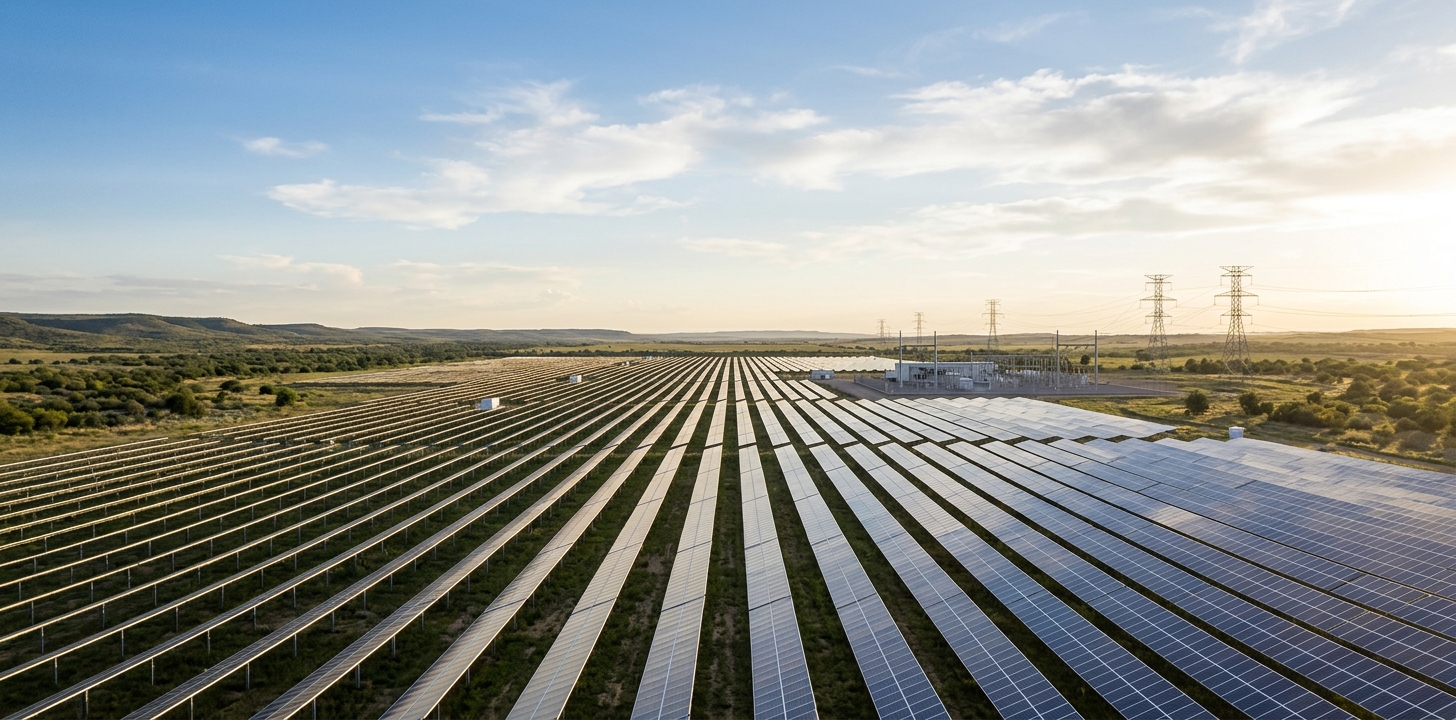
A solar farm is a large collection of interconnected solar panels designed to convert sunlight into electricity. These facilities are also known as utility-scale solar facilities, photovoltaic power stations, or solar parks. Unlike individual rooftop solar systems, solar farms distribute electricity to hundreds or thousands of people by feeding power directly into the electrical grid¹.
The primary purpose of a solar farm is to sell the generated electricity wholesale or retail into the US electrical grid. This process delivers clean energy to a broad base of consumers. It also helps stabilize energy prices by reducing reliance on fossil fuels.
How Solar Farms Work
Most solar farms use photovoltaic (PV) panels, which are the same type of panels found on residential rooftops. These panels capture sunlight and convert it into direct current (DC) electricity. Inverters then change this DC electricity into alternating current (AC), which is compatible with the existing electrical grid.
Some solar farms also use concentrated solar power (CSP) systems, which use mirrors to focus sunlight onto a receiver to generate heat, which then drives a turbine to produce electricity. While PV is more common for large-scale solar farms, CSP offers another method for utility-scale power generation. You can learn more about how this technology works by reading "What is Concentrated Solar Power (CSP)?".
Size and Scale
Utility-scale solar farms typically range from 1 megawatt (MW) to over 1,000 MW in capacity. For comparison, typical home solar systems generate between 4-10 kilowatts (kW) of power. Most US utility-scale solar power plants produce between 1-5 MW, though some can exceed 50 MW.
These large facilities can be built on various types of land. Common locations include open land, farmland (sometimes integrated with agriculture, known as agrivoltaics), former industrial sites, capped landfills, rooftops of large commercial buildings, or parking lots.
A utility-scale solar power plant may require between 5 and 7 acres per MW of generating capacity. However, other sources suggest 5-10 acres per MW or even 7-12 acres/MW for fixed tilt systems, and 10-15 acres/MW with trackers and setbacks. A conservative estimate for solar development often uses 10 acres per 1 MW, accounting for site development². Developers typically look for a minimum of 200 acres of usable land for utility-scale projects.
The actual land needed for a solar farm varies significantly based on factors like local sun exposure, equipment efficiency, and land characteristics (such as wetlands or inclines)².
Powering the Grid
In 2023, solar energy accounted for 3.9% of the electricity generated by utility-scale facilities in the US. The US solar industry is growing rapidly. The US Energy Information Administration (EIA) projected a record 86 gigawatts (GW) of new utility-scale generating capacity to be added to the US grid in 2026. Solar power is expected to account for 51% (43.4 GW) of these additions in 2026, a 60% increase over 2025³.
This expansion is largely driven by new utility-scale solar farms and grid-scale battery projects. Over half of the new utility-scale solar capacity in 2026 is planned for Texas (40%), Arizona (6%), California (6%), and Michigan (5%). Texas's Tehuacana Creek 1 Solar and BESS project, for example, is the largest solar photovoltaic project expected in 2026, adding 837 MW of solar and 418 MW of battery storage³.
The US solar fleet is projected to double in the next five years, with average annual additions of approximately 43 GWdc between 2026 and 2031⁴. As of 2025, utility-scale solar farms had a total capacity of 161 GW nationwide, enough to power nearly 34 million homes⁵.
Economic Impact and Costs
The US solar industry is a significant economic powerhouse. As of July 2025, it represented over $70 billion in private investment and supported more than 280,000 solar-related jobs. The role of 'solar photovoltaic installer' is among the fastest-growing professional roles in America⁶.
Installation Costs
Solar farm installation costs in 2026 range from $300,000 to $1,600,000, with an average around $950,000. Utility-scale solar PV project capital expenditure (CAPEX) in the US in 2026 typically falls between $900,000 and $1.3 million per MW of DC capacity⁵.
This CAPEX includes hardware, construction, soft costs, permitting, legal fees, environmental reviews, and interconnection studies. Module and tracker costs represent roughly 35% to 45% of total project CAPEX. Utility-scale solar is significantly cheaper per watt ($0.95-$1.23 per watt) compared to residential installations. For example, a 1 MW solar farm can cost approximately $980,000, excluding land costs⁵.
Long-Term Value
Solar farms provide long-term price stability in energy production, as their costs are not influenced by fluctuating fossil fuel prices⁷. The levelized cost of electricity (LCOE) for utility-scale solar ranges between $40/MWh and $98/MWh in 2026. Even with rising costs across all generation types, unsubsidized renewable energy remains the most cost-competitive form of new-build generation⁵.
These projects can generate positive cash flow for 25-30 years due to wholesale electricity sales and low operating costs⁵. Utility-scale solar projects also contribute millions of dollars in tax revenue for local and regional governments and provide supplemental revenue to landowners through leases⁷.
Environmental Benefits and Challenges
Solar farms offer substantial environmental benefits, particularly by reducing reliance on fossil fuels. They do not produce air pollution or greenhouse gases during operation. In fact, solar farms produce 95% less lifecycle emissions than coal plants and 81% less than natural gas plants. By displacing fossil fuel generation, solar energy significantly reduces carbon emissions and contributes to a healthier environment, with estimated public health benefits of 5-10 cents per kWh⁷.
Resource Use and Conservation
Solar farms use minimal water for electricity generation, unlike some conventional power methods. When replacing conventional row crops, solar farms can reduce sediment and phosphorus pollution runoff by 75-95% and increase soil carbon sequestration by 65% when perennial vegetation is planted. Planting perennial vegetation can also improve wildlife habitat, including a 300% improvement for pollinators. More than 90% of a solar project's land is protected and not used by infrastructure, allowing for habitat enhancement⁷.
Solar panels are designed to last 25 years or longer, with some operating for over 40 years. Efforts are underway to extend panel lifespans up to 50 years and improve recycling processes. Over 85% of a solar panel can be recycled.
Potential Drawbacks
Despite the benefits, solar farm development does present some environmental challenges. Clearing land for solar arrays can disrupt wildlife habitats and reduce biodiversity. Construction activities, such as grading and trenching, can lead to soil compaction, erosion, and altered drainage channels. Increased water runoff and sedimentation could potentially contaminate waterways.
The manufacturing of PV cells involves hazardous chemicals that require careful handling and disposal. Some PV cells also contain heavy metals. Proper recycling and disposal practices are crucial to mitigate these impacts.
Consumer Participation: Community Solar
Many homeowners cannot install rooftop solar due to high upfront costs, unsuitable roofs, or being renters. Community solar programs offer a solution by allowing multiple participants—homeowners, renters, businesses, and non-profits—to benefit from a single, often off-site, solar array¹. These projects typically range from 1-5 MW⁸.
How Community Solar Works
Participants in a community solar program subscribe to a portion of the solar energy produced by the shared array. In return, they receive credits on their electricity bills, which typically leads to reduced energy costs (often 5-20% savings)¹. This approach expands access to solar for individuals and organizations who might otherwise be excluded.
The US community solar sector surpassed 10 gigawatts (GWdc) of cumulative installations by the end of 2025. While installations contracted by 25% in 2025, national installed capacity is expected to rebound with 12% growth in 2026. This rebound is driven by growth in states like Illinois and those in the Mid-Atlantic. The US Department of Energy aims for 25 GW of community solar by 2025. The Coalition for Community Solar Access (CCSA) predicts over 30 GW by 2030.
Economic and Policy Drivers
Community solar delivers significant economic impact. For instance, 750 MW of community solar development can generate approximately $2.1 billion in economic impact and create over 14,000 local jobs. The market is driven by favorable policies, technological advancements, and increasing environmental awareness.
Key states leading the charge in community solar include California, New York, Massachusetts, and Minnesota. Utility-sponsored programs, where utilities own and operate the arrays, are common. Customers can subscribe and receive bill credits. Partnerships involving utilities, non-profits, and financial institutions are crucial for expanding community solar, particularly for low-to-moderate-income (LMI) households. This integration with utilities is a key aspect of "Going Solar With Your Utility".
Pros
-
Access to solar for renters or homes with unsuitable roofs.
-
Reduced energy costs, typically 5-20% savings¹.
-
No upfront installation costs for participants.
-
Supports local renewable energy development.
Cons
-
Savings may be less than direct rooftop ownership.
-
Availability depends on state and local programs.
-
Limited control over the physical solar array.
Sources:
What's a Solar Farm, Solar Park, or Solar Garden? How They Work (perchenergy.com)
Frequently Asked Questions (linncountyiowa.gov)
US EIA forecasts record 86 GW of power capacity additions in 2026 (enerdata.net)
Where US solar demand is headed in 2026 (payaca.com)
Solar Farms Guide: Large-Scale Solar Power & Economics 2026, 2025 (a1solarstore.com)
Solar Industry: A Driving Force for Economic Growth, Job Creation (ases.org)
The Benefits of Solar Farms for the Environment and Economy (getsolarlabels.com)
What Is a Solar Farm? (altuspower.com)
Deana is a Home Improvement Editor with a passion for helping homeowners navigate renovation, repair, and remodeling with confidence. Specializing in roofing, kitchen and bath remodeling, and outdoor living spaces, she combines industry knowledge with a genuine commitment to making complex home projects feel approachable for readers at every stage of their journey. Her path into home improvement media began after several years working alongside ...
Learn more about Deana Barbaro