Updated 4 weeks ago
IRS Form 5695 Instructions: How to Claim the Solar Tax Credit (2025 Tax Year)
Written by
Ben Zientara

You can lower the cost of solar panels by 30% with the federal tax credit
It’s that time of year again—tax time! But this year is different because this was the year you installed solar panels on your home (or qualifying property) and are now ready to claim the federal solar tax credit for the 2025 tax year. And we’re here to help guide you through the process!
To claim the solar tax credit, you’ll need all the receipts from your solar installation, as well as IRS form 1040 and form 5695 and instructions for both of those forms.
We’ve included an example below of how to fill out the tax forms and some frequently asked questions about the process of claiming the 30% tax credit for systems placed in service by December 31, 2025.
We are solar people, not tax people. We do not give tax advice; anything you read on this page is merely one example of how someone might act. Please consult a tax professional before filing.
What you need to claim the tax credit
The receipts from your solar installation
IRS Form 1040, which is your individual income tax return
IRS Form 1040, Schedule 3, where you calculate additional credits and payments
IRS Form 5695, which is the Residential Energy Credit form
Residential Clean Energy Credit Limit Worksheet - Line 14 to help calculate the tax credit value
Instructions for these forms (also available from the links above)
Fill out your Form 1040 as you normally would. Stop when you reach line 20, and move to Schedule 3, where you can fill in other payments and additional credits, like the solar tax credit. To figure out your tax credit value, you’ll use Form 5695.
How to fill out form 5695
Today, we’re helping “Example Exampleson,” who hails from Minnesota, dontcha know. His 6.2 kW solar panel installation cost $15,500, and he is now filling out his tax forms for the year. Here’s how he did it:
Step 1: Fill out Line 1 with qualified solar electric property costs
Mr. Exampleson begins working on his Residential Energy Credit form by filling out line 1 of form 5695 with the total cost of his solar system ($15,500):
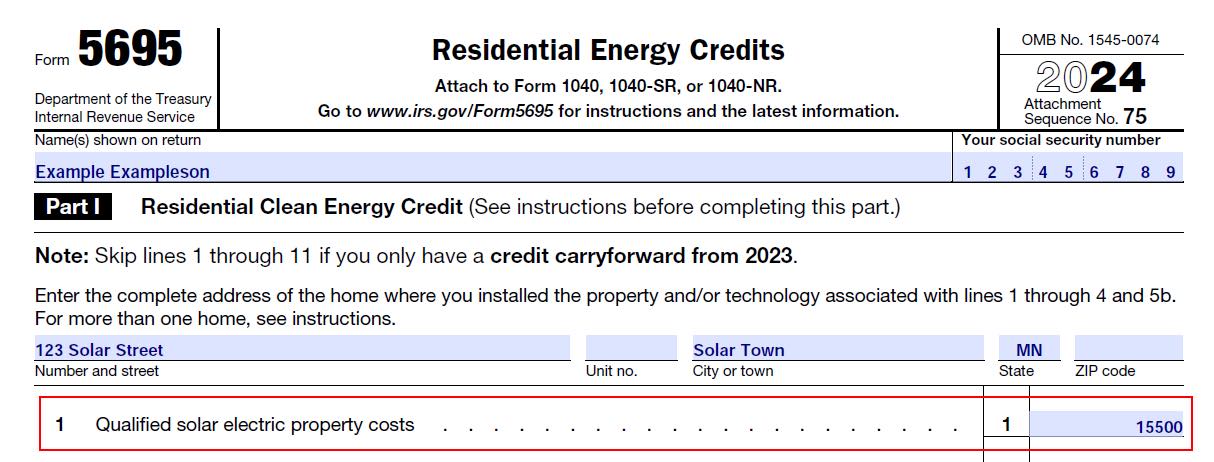
What exactly is a qualified solar electricity property cost? Here’s what the instructions for Form 5695 say:
"Include any labor costs properly allocable to the onsite preparation, assembly, or original installation of the residential energy efficient property and for piping or wiring to interconnect such property to the home.
Qualified solar electric property costs are costs for property that uses solar energy to generate electricity for use in your home located in the United States. No costs relating to a solar panel or other property installed as a roof (or portion thereof) will fail to qualify solely because the property constitutes a structural component of the structure on which it is installed. Some solar roofing tiles and solar roofing shingles serve the function of both traditional roofing and solar electric collectors, and thus serve functions of both solar electric generation and structural support. These solar roofing tiles and solar roofing shingles can qualify for the credit. This is in contrast to structural components such as a roof's decking or rafters that serve only a roofing or structural function and thus do not qualify for the credit. The home does not have to be your main home."
All that is a fancy way of saying “Pretty much any cost related to installation and materials of solar energy generating property counts. Claim it.”
Battery storage is a separate line. If you also installed a solar battery, it may qualify for the 30% Residential Clean Energy Credit, even if installed standalone, provided it has a capacity of at least 3 kilowatt-hours (kWh). Check the instructions for Form 5695 to see if your energy system qualifies. If it does, check Yes on line 5a, and enter the qualified battery technology costs on line 5b.
Step 2: Calculate the total credit value
If you installed other qualifying energy properties, fill out their respective costs on lines 2 through 5. Then, add together the values of lines 1 through 5b to get the total value of your renewable energy costs and fill in line 6a.
Multiply the value in 6a by 30%, and enter the amount in column 6b. That is the value of your tax credit.
Note: If your installation included battery energy storage with more than 3 kilowatt-hours of capacity, you can claim those costs on this form as well. Costs for energy storage go on line 5b and get added together with solar costs on line 6a. The 30% credit for battery storage applies to equipment, labor, and wiring costs. For the Residential Clean Energy Credit, qualifying battery-storage expenditures must have been made by December 31, 2025.
Mr. Exampleson got a solar-only system without a battery, so he fills in line 6a with his qualified solar costs of $15,500. This means his tax credit value is $4,650.
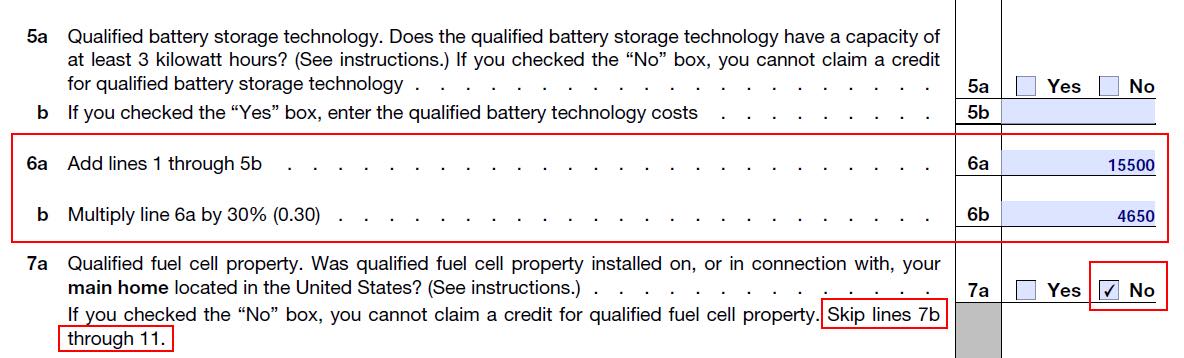
Skip to line 12 unless you installed fuel cell property, and enter in any credit you’re carrying over from a qualified energy property installation (like a previous solar installation) from the previous year. Then fill in line 13 with the total amount of credit from lines 6, 11, and 12. In Mr. Exampleson’s case, he has no prior-year credit to add, so he just puts the same $4,650 from line 6:

Step 3: Form 5695 line 14 worksheet
Line 14 is where it gets tricky. The Residential Clean Energy Credit is nonrefundable, meaning it can reduce your federal income tax liability but cannot generate a refund beyond the amount of tax you owe. If the credit exceeds the applicable tax-liability limit, the unused portion can generally be carried forward.
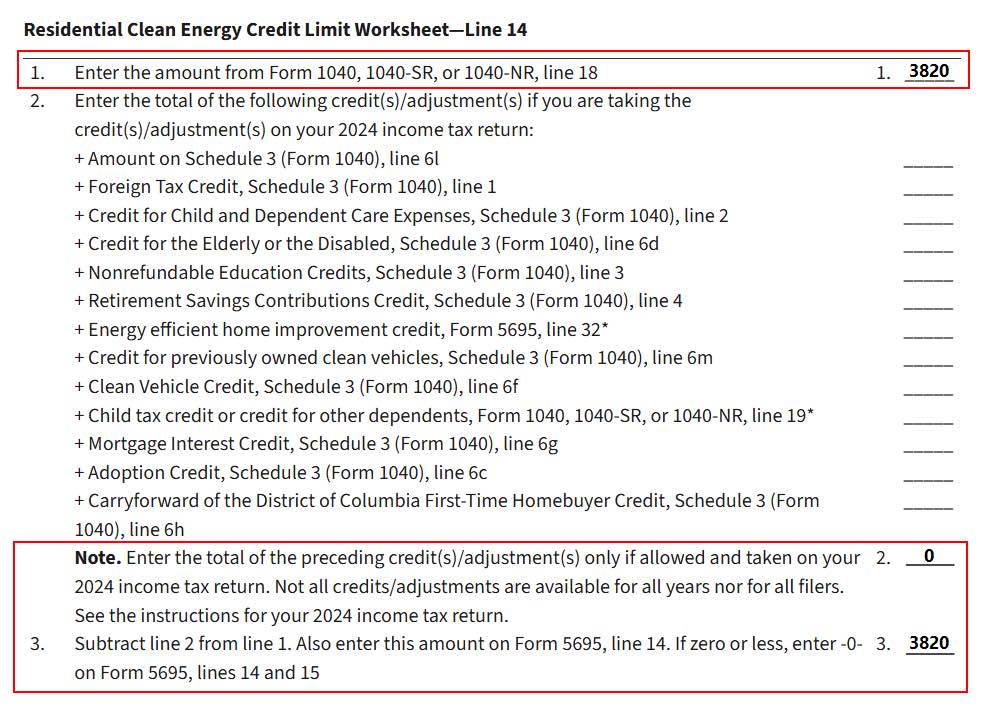
Enter the amount from line 18 of Form 1040, 1040-SR, or 1040-NR on line 1 of the worksheet. On line 2, add together any of the specific credits and adjustments listed in the worksheet that apply to your 2025 tax return, such as the foreign tax credit, child and dependent care credit, nonrefundable education credits, and certain other credits.
Subtract line 2 from line 1. Enter the result on line 3 of the worksheet and on line 14 of Form 5695. This amount determines the tax liability limit used to calculate how much of the Residential Clean Energy Credit you can use for 2025. If you cannot use the full credit because of this limit, the unused portion can be carried forward to 2026.
Here’s what the line 14 worksheet looks like for Mr. Exampleson, who has an initial tax liability (listed on line 1 below) of $3,820 this year and can claim no other tax credits:
Step 4: Form 5695 Line 14 reducing the credit
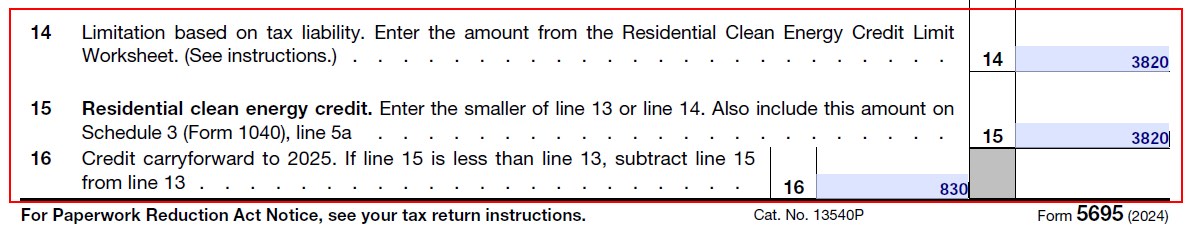
Because Mr. Exampleson’s applicable tax-liability limit is $3,820, that’s the maximum amount of the credit he can use for 2025. He enters that number on lines 14 and 15 of Form 5695. Because his total tax credit value is $4,650, but he can only use $3,820, he has $830 remaining to carry forward to offset future tax bills. He fills out line 16 with $830.
Step 5: Fill out IRS Form 1040 Schedule 3
Finally, he enters the $3,820 into line 5a of Schedule 3 from line 15 on Form 5695.
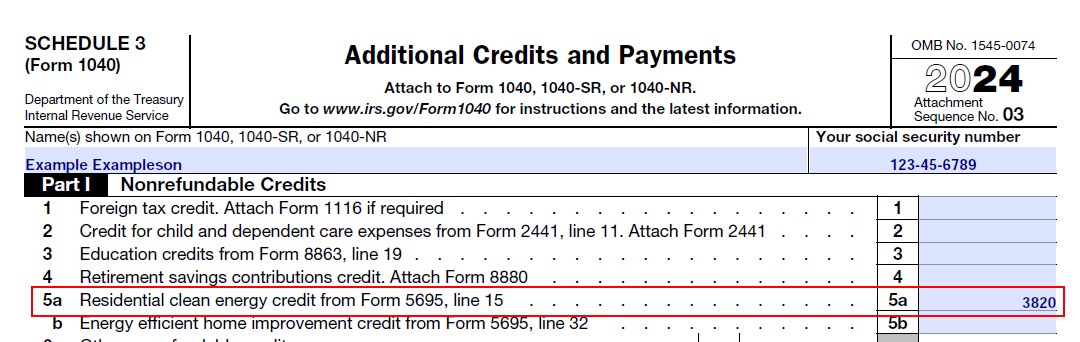
That’s it! In this example, $3,820 of the credit can be used for 2025, while the remaining $830 is carried forward. Although the credit has ended for new qualifying expenditures after 2025, the 2025 Form 5695 instructions allow unused Residential Clean Energy Credit from 2025 to be carried forward to 2026. Now he can send his documents to his financial advisor to make sure everything checks out before officially filing.
Frequent Form 5695 questions and considerations
Sources:
How the 30% Federal Solar Tax Credit Works in 2025: Save Big (avebattery.com)
Residential Clean Energy Credit: What It Is & What Qualifies (blog.turbotax.intuit.com)
storeenergy.com (ca.storeenergy.com)
2025 Federal Solar Tax Credit Guide: Expert Insights to Help You Save (cedarcreekenergy.com)
Residential Clean Energy Tax Credit (goalzero.com)
25D Rooftop Solar Federal Tax Credits: A Guide for Homeowners (homes.rewiringamerica.org)
Sales and Property Tax Exemptions for Solar Panels (palmetto.com)
Solar Tax Exemptions (seia.org)
Form 5695 Guide 2025: Complete Instructions For Residential Energy Credits (solartechonline.com)
Ben Zientara is a writer, researcher, and solar policy analyst who has written about the residential solar industry, the electric grid, and state utility policy since 2013. His early work included leading the team that produced the annual State Solar Power Rankings Report for the Solar Power Rocks website from 2015 to 2020. The rankings were utilized and referenced by a diverse mix of policymakers, advocacy groups, and media including The Center...
Learn more about Ben Zientara